Do you cringe at the memories of the meetings you have sat through?
So many meetings are unproductive, boring, and inefficient, that comedians thrive on jokes about them.
Classic ...
How many managers does it take to change a light bulb?
1) A roomful - they have to hold a meeting to discuss all the ramifications of the change.
2) None, they like to keep employees in the dark.
3) "This topic was resumed from last week's discussion, but is incomplete pending resolution of some action items. It will be continued next week. Meanwhile ..."
4) "We've formed a task-force to study the problem of why light bulbs burn out, and to figure out what, exactly, we as supervisors can do to make the bulbs work smarter, not harder."
Nevertheless it's not a joke when you are sitting through the frustration ...,
when you know that you are wasting time and money in meetings that aren't productive
when you cannot achieve anything because of the undisciplined "waffle" and going around and around in circles discussing.
.......
This eBook will show you how to save both time and money
"Make your Meetings work" the eBook ... gives you the secrets of organising your meetings so that they are more efficient and more effective.
This eBook gives you strategies that can make your meetings productive, saving you time and money - yours and the company's.
More information on Make your meetings work
Wednesday, February 04, 2009


Sunday, February 01, 2009
Staying focused when tough times are ahead
While it is easy to inspire people when the business is going well, the best leaders inspire people when times are tough. Following are three suggestions, based upon what I have learned from my coaching clients:
- The first person that you need to keep focused is YOU ...
http://adjix.com/3dsm
- The first person that you need to keep focused is YOU ...
http://adjix.com/3dsm
Tuesday, January 27, 2009
Leadership and Change
Carol Bartz's Challenge at Yahoo: Choose a Path, Build a Team and Do It Fast
New Yahoo CEO Carol Bartz has a long to-do list -- chart the company's strategy, weigh a potential search partnership with Microsoft, boost morale and round out her management team -- and not much time to deliver amid a weak economy that is hurting online advertising, say experts at Wharton.
http://knowledge.wharton.upenn.edu/article/2142.cfm
New Yahoo CEO Carol Bartz has a long to-do list -- chart the company's strategy, weigh a potential search partnership with Microsoft, boost morale and round out her management team -- and not much time to deliver amid a weak economy that is hurting online advertising, say experts at Wharton.
http://knowledge.wharton.upenn.edu/article/2142.cfm
Saturday, January 10, 2009
A Case for Inspirational Leadership
There are hardly any leadership or management books out there that do not talk about inspirational leadership. So why another post on the topic of inspiration? Around 2 million jobs were eliminated in 2008. In October, a CNN poll found that 59 percent of Americans believe another 1930s-style depression is very or somewhat likely. A separate poll for Condé Nast Portfolio shows that people working in the finance business are even gloomier: 77 percent of them say their industry is in a state of crisis, and 50 percent say the economy is the worst it has been in their careers.
Thus given the circumstances it is even more important that leaders at every level keep their teams inspired, motivated and focused.
http://adjix.com/a97y
Thus given the circumstances it is even more important that leaders at every level keep their teams inspired, motivated and focused.
http://adjix.com/a97y
Monday, January 05, 2009
10 Suggestions for Self-aware Leadership in 2009
Sunday, December 28, 2008
Sustainability Is No Longer 'Niche'
Coca-Cola's John Brock:
John Brock has come a long way since his first jobs working in his uncle's dime store and, later, at a paper mill in Moss Point, Miss. Today, he is chairman and CEO of Coca-Cola Enterprises, the world's largest marketer, producer and distributor of Coca-Cola products. Brock has more than 25 years of experience in the beverage sales industry. In 2003, he was named CEO of Interbrew, headquartered in Brussels, Belgium. In 2006, he joined Coca-Cola Enterprises where he was appointed chairman in April 2008. Brock talked with Knowledge@Wharton about Coke's philosophy on selling soda in schools, helping the environment and recruiting teens to become devoted customers.
http://adjix.com/47y9
John Brock has come a long way since his first jobs working in his uncle's dime store and, later, at a paper mill in Moss Point, Miss. Today, he is chairman and CEO of Coca-Cola Enterprises, the world's largest marketer, producer and distributor of Coca-Cola products. Brock has more than 25 years of experience in the beverage sales industry. In 2003, he was named CEO of Interbrew, headquartered in Brussels, Belgium. In 2006, he joined Coca-Cola Enterprises where he was appointed chairman in April 2008. Brock talked with Knowledge@Wharton about Coke's philosophy on selling soda in schools, helping the environment and recruiting teens to become devoted customers.
http://adjix.com/47y9
Saturday, December 20, 2008
Practical tips to improve Manager/Employee communication styles
leveraging the MBTI
Many of my clients utilize the MBTI® to coach managers on how to communicate more effectively with their employees.
They have shared that their biggest challenge is providing useful tips that the managers can easily integrate into their day-to-day interactions with their employees.
To address this challenge, I have created the table below which lists potential challenges or conflicts for individuals that have different personality preferences.
I also included suggested techniques that managers can try when communicating with individuals who have a different personality preference.
http://adjix.com/v35
Many of my clients utilize the MBTI® to coach managers on how to communicate more effectively with their employees.
They have shared that their biggest challenge is providing useful tips that the managers can easily integrate into their day-to-day interactions with their employees.
To address this challenge, I have created the table below which lists potential challenges or conflicts for individuals that have different personality preferences.
I also included suggested techniques that managers can try when communicating with individuals who have a different personality preference.
http://adjix.com/v35
Thursday, December 04, 2008
Improve Your Meetings

Deborah Mackin, author of the new Team Building Tool Kit, talks about the statistics of a typical meeting and shares easy tools for making high performance, highly productive team meetings.
Monday, November 24, 2008
Meetings 101
If you want to have more effective meetings, first you have to learn the basics. Here are some simple, easy-to-follow and proven guidelines that should be followed each and every time your group meets.
Print this page. Hang it on your meeting room wall. Write the guidelines on a poster. Memorize them by heart. Do whatever it's going to take to improve your meetings!
Guidelines you and your group can follow before, during and after your meeting
Friday, November 21, 2008
Assessing Your Organization's Innovation Capabilities
This article offers a framework to help managers confronted with necessary change understand whether the organizations over which they preside are capable or incapable of tackling the challenge.
(...more)
(...more)
Tuesday, November 18, 2008
Marketing and media
Q. How regularly do media need to be contacted to keep an environment issue alive?
There is a fine line for groups to walk when it comes to keeping the media updated on a long‐running issue that has been – and will continue to be – in the news.
Not contacting the media often enough can see your story fade from the headlines. But if you contact specific media outlets or journalists too often, you run the risk of being tagged a serial pest and being ignored by the very media you seek to carry your story.
One easy way to decrease the chances of being labelled a serial pest is to build solid relationships with the media outlets and journalists you deal with. This will allow you to bounce ideas off journalists, to call more informally and update them on the latest news about your issue, or to ask them if they are interested in a certain story or angle.
These relationships are especially important when working with the media on a long‐term or ongoing issue – if a journalist knows you, and is familiar with your story, they are more likely to give you more of their time and a friendlier ear.
It also means you can cut down on the amount of “backgrounding” you have to give journalists, allowing you to quickly “cut to the chase” when talking with them.
One key tip: Find out when the journalists in your contact list are “on deadline”. Avoid those times when you make contact and you’ll be less likely to be given short shrift.
Q. As small community not‐for‐profit organisation in what ways can I market the broad range of services we offer? How do I develop a marketing strategy?
A marketing strategy is not something that can be whipped up at the drop of a hat. Assembling a good, solid marketing plan can take hard work, analysis, preparation and knowledge of your current standing and resources.
The first thing you should look at is your group’s current situation: its current stakeholders and partners, its current standing and performance, and the current context or environment it operates in.
From there, a SWOT analysis will build on this information and further clarify the Strengths, Weaknesses, Opportunities and Threats which face your organisation. All this information will help your group know the issues it needs to focus its plan around, and form strategies to let you do that – for example: “We want to sign up 50 new sponsors between now and the end of the year.”
Take particular notice of your SWOT analysis – using your strengths and opportunities to best achieve your marketing aims while avoiding or fixing your weaknesses and noting the threats your group might face.
Then, work through an action plan or list of things your group must do in order to achieve its stated objective. What must you do? Who will do it? When will it be done? How much will it cost? How will you know if you’ve achieved those aims?
Finally, examine your resources – your people power, your finances and technology – as well as those resources you might need, and draw up a budget for the marketing effort. Of course, once the plan is approved, it will only succeed if there is constant monitoring, appraisal and review. Keep track of the plan’s progress and, if necessary, modify it. Devote a generous amount of time to the plan’s development to ensure the process is thorough and to increase its chances of success.
The Marketing Guru is an initiative of the Marketing, Media and Post Centre, the online resource for community organisations provided by Our Community and Australia Post. You can send your marketing and media questions to guru@ourcommunity.com.au.
There is a fine line for groups to walk when it comes to keeping the media updated on a long‐running issue that has been – and will continue to be – in the news.
Not contacting the media often enough can see your story fade from the headlines. But if you contact specific media outlets or journalists too often, you run the risk of being tagged a serial pest and being ignored by the very media you seek to carry your story.
One easy way to decrease the chances of being labelled a serial pest is to build solid relationships with the media outlets and journalists you deal with. This will allow you to bounce ideas off journalists, to call more informally and update them on the latest news about your issue, or to ask them if they are interested in a certain story or angle.
These relationships are especially important when working with the media on a long‐term or ongoing issue – if a journalist knows you, and is familiar with your story, they are more likely to give you more of their time and a friendlier ear.
It also means you can cut down on the amount of “backgrounding” you have to give journalists, allowing you to quickly “cut to the chase” when talking with them.
One key tip: Find out when the journalists in your contact list are “on deadline”. Avoid those times when you make contact and you’ll be less likely to be given short shrift.
Q. As small community not‐for‐profit organisation in what ways can I market the broad range of services we offer? How do I develop a marketing strategy?
A marketing strategy is not something that can be whipped up at the drop of a hat. Assembling a good, solid marketing plan can take hard work, analysis, preparation and knowledge of your current standing and resources.
The first thing you should look at is your group’s current situation: its current stakeholders and partners, its current standing and performance, and the current context or environment it operates in.
From there, a SWOT analysis will build on this information and further clarify the Strengths, Weaknesses, Opportunities and Threats which face your organisation. All this information will help your group know the issues it needs to focus its plan around, and form strategies to let you do that – for example: “We want to sign up 50 new sponsors between now and the end of the year.”
Take particular notice of your SWOT analysis – using your strengths and opportunities to best achieve your marketing aims while avoiding or fixing your weaknesses and noting the threats your group might face.
Then, work through an action plan or list of things your group must do in order to achieve its stated objective. What must you do? Who will do it? When will it be done? How much will it cost? How will you know if you’ve achieved those aims?
Finally, examine your resources – your people power, your finances and technology – as well as those resources you might need, and draw up a budget for the marketing effort. Of course, once the plan is approved, it will only succeed if there is constant monitoring, appraisal and review. Keep track of the plan’s progress and, if necessary, modify it. Devote a generous amount of time to the plan’s development to ensure the process is thorough and to increase its chances of success.
The Marketing Guru is an initiative of the Marketing, Media and Post Centre, the online resource for community organisations provided by Our Community and Australia Post. You can send your marketing and media questions to guru@ourcommunity.com.au.
Wednesday, November 12, 2008
The Manager's Guide to Effective Meetings

by Barbara J. Streibel
In our increasingly collaborative work environment, the ability to manage results-driven meetings has become a critical career asset. Let The Manager's Guide to Effective Meetings provide you with a step-by-step template for energizing your next meeting, and transforming it from a roomful of clock-watching individuals into a collaboration of involved and enthusiastic partners. (more ...)
Buy the book from Amazon or, if you are a Pivotal Gold Member, request your free copy. Not a member? Join here
Saturday, November 01, 2008
The Power of Ordinary Practices
Seemingly mundane things that managers do can have great impact on their workers, says Professor Teresa Amabile. In this conversation with Professor Mike Roberts, she updates her ongoing research on creativity in the workplace by investigating how people's intense inner work lives affect their productivity—and how managers can encourage production.
(... more)
(... more)
Sunday, October 26, 2008
How do I get state-wide media to take notice of local issues?
This is a common challenge for many locally-based community organisations which are able to hit the headlines successfully in their local area, but struggle to match this local publicity on a state basis.
The key is to make the issue relevant to the audience you are targeting; in this case, the entire state.
Make it very clear how your local issue is relevant to other parts of the state. Is it opposition tocertain types of development, the destruction of parks or wetlands, a shortage of publichousing, a legal hiccup or government decision that could affect many?
Think of the local issue as an example or case study of the wider problem. Show how it could impact oncommunities across the state.Without this type of wider relevance, hopes of wider media coverage are slim.
Of course, there is also a much greater level of competition for coverage at a state level. You’ll have to work that much harder to gain coverage.
So, in addition to a great hook, it is almost certain you will need to organise good visual opportunities forphotos (print publications) or footage (TV).
Staging an event, protest or some other attention-grabbing activity is one way of doing this. If you do go this route, try to stage your event on a weekend, preferably a Sunday when there’s less competition.
Does it strengthen or weaken my brand to use a new logo in a merchandising program – plastering iton merchandise of relevance to the organisation?
The classic answer here is: “It depends”.
It is very important that your logo is used thoughtfully and in context, not gratuitously or in away that denigrates or cheapens your organisational brand.
Generally speaking, if you are going to use your group’s new logo on merchandise, there are some basic rules to follow:
• Show restraint – Don’t fall into the trap of putting your logo on everything. Pick and choose your targets in terms of what the most number of people will see, and what people will hold on to thelongest.
• Not too large, not too small – Jumbo-sized logos on merchandise look cheap. Too small, and noone will be able to see it. Use a medium-sized logo that doesn’t overwhelm the item it is placed on.
• Convey a message – Where possible, convey your message with your logo. Does your group have ashort slogan, catchphrase or tagline it can use in conjunction with the image?
Respect your logo like you do your group’s good name and reputation. Your logo is an expansion of your group and its brand – damage it, and you run the risk of doing the same to your group and brand.
The Marketing Guru is an initiative of the Marketing, Media and Post Centre, the online resource forcommunity organisations provided by Our Community and Australia Post. Send your questions to guru@ourcommunity.com.au.
The key is to make the issue relevant to the audience you are targeting; in this case, the entire state.
Make it very clear how your local issue is relevant to other parts of the state. Is it opposition tocertain types of development, the destruction of parks or wetlands, a shortage of publichousing, a legal hiccup or government decision that could affect many?
Think of the local issue as an example or case study of the wider problem. Show how it could impact oncommunities across the state.Without this type of wider relevance, hopes of wider media coverage are slim.
Of course, there is also a much greater level of competition for coverage at a state level. You’ll have to work that much harder to gain coverage.
So, in addition to a great hook, it is almost certain you will need to organise good visual opportunities forphotos (print publications) or footage (TV).
Staging an event, protest or some other attention-grabbing activity is one way of doing this. If you do go this route, try to stage your event on a weekend, preferably a Sunday when there’s less competition.
Does it strengthen or weaken my brand to use a new logo in a merchandising program – plastering iton merchandise of relevance to the organisation?
The classic answer here is: “It depends”.
It is very important that your logo is used thoughtfully and in context, not gratuitously or in away that denigrates or cheapens your organisational brand.
Generally speaking, if you are going to use your group’s new logo on merchandise, there are some basic rules to follow:
• Show restraint – Don’t fall into the trap of putting your logo on everything. Pick and choose your targets in terms of what the most number of people will see, and what people will hold on to thelongest.
• Not too large, not too small – Jumbo-sized logos on merchandise look cheap. Too small, and noone will be able to see it. Use a medium-sized logo that doesn’t overwhelm the item it is placed on.
• Convey a message – Where possible, convey your message with your logo. Does your group have ashort slogan, catchphrase or tagline it can use in conjunction with the image?
Respect your logo like you do your group’s good name and reputation. Your logo is an expansion of your group and its brand – damage it, and you run the risk of doing the same to your group and brand.
The Marketing Guru is an initiative of the Marketing, Media and Post Centre, the online resource forcommunity organisations provided by Our Community and Australia Post. Send your questions to guru@ourcommunity.com.au.
Sunday, October 19, 2008
Our Community Photo Bank
Our Community and Australia Post are working together to build up a gallery of photos that show the full extent of Australia’s communities and the people who work with them. A total of $5000 in cash prizes is available for photographers who upload images to the Photo Bank, and their nominated community groups. There are two prizes – one for the most popular photo, and another for the photo that best exemplifies the work of Australian community.
The competition is open until October 22, but photos will remain on the Photo Bank indefinitely. Find out more and view existing photographs at
www.ourcommunity.com.au/photobank.
Don’t miss your chance to show the rest of Australia what’s going on in your neck of the woods – and maybe win some loot while you’re at it.
The competition is open until October 22, but photos will remain on the Photo Bank indefinitely. Find out more and view existing photographs at
www.ourcommunity.com.au/photobank.
Don’t miss your chance to show the rest of Australia what’s going on in your neck of the woods – and maybe win some loot while you’re at it.
Tuesday, October 14, 2008
Communication Success Tip
[From Parsons Associates Coaching]
Think before you speak.
Saying what you mean and meaning what you say is the golden rule to communication.
To achieve this, you must hear what you are saying before it is spoken.
This requires pausing for a moment of thought.
Analyze what you plan to say and evaluate whether it sounds like what you mean.
When you speak to someone you don’t have a backspace key to erase what you just said.
Saturday, October 11, 2008
Video - Sharing - the Leadership Challenge

See practical examples of this particular style of leadership in change in the public sector
Sunday, October 05, 2008
Top Five tips for a healthy event
[From Our Community Matters, the newsletter of http://www.ourcommunity.com.au/]
If you're taking care of the health of both your volunteers and the general public (and you should be), take these considerations into account when planning your next fundraising event.
1. Free and easily accessible water
You may think you can make more money by selling your own cans (and perhaps forbidding other people from bringing their own), but this is very risky. If anyone gets dehydrated you may be held liable. Make sure
that volunteers have a clear source of hydration, even if you have to buy it.
2. Adequate first aid
You may be able to get this expertise from within your own volunteer roster that is, you may be able to arrange for your volunteers to take the course. If n, thought, you'll have to mae other arrangements.
3. Smoke-free areas
This is a no-brainer. Slightly harder is the question of whether to have an entirely smoke-free event. Will this discourage participants? On the other hand, is it ethical to facilitate ill-health? Will it cheapen your brand?
4. Shaded areas
Any outdoors event venue needs to have as much shade as possible.
To set a good example volunteers should be encouraged to be SunSmart (a long-sleeved collared shirt, sunglasses and a broad-rimmed hat when outdoors).
5. Healthy publicity
These tips do involve you doing more work, so you need to get something back for the cause. Try and make it a sales feature. Promote your healthy event in your media campaign and stress how friendly it is to families (working families, even!). Explain any restrictions to volunteers in advance.
Keep it fun, keep it healthy, and minimise risks.
If you're taking care of the health of both your volunteers and the general public (and you should be), take these considerations into account when planning your next fundraising event.
1. Free and easily accessible water
You may think you can make more money by selling your own cans (and perhaps forbidding other people from bringing their own), but this is very risky. If anyone gets dehydrated you may be held liable. Make sure
that volunteers have a clear source of hydration, even if you have to buy it.
2. Adequate first aid
You may be able to get this expertise from within your own volunteer roster that is, you may be able to arrange for your volunteers to take the course. If n, thought, you'll have to mae other arrangements.
3. Smoke-free areas
This is a no-brainer. Slightly harder is the question of whether to have an entirely smoke-free event. Will this discourage participants? On the other hand, is it ethical to facilitate ill-health? Will it cheapen your brand?
4. Shaded areas
Any outdoors event venue needs to have as much shade as possible.
To set a good example volunteers should be encouraged to be SunSmart (a long-sleeved collared shirt, sunglasses and a broad-rimmed hat when outdoors).
5. Healthy publicity
These tips do involve you doing more work, so you need to get something back for the cause. Try and make it a sales feature. Promote your healthy event in your media campaign and stress how friendly it is to families (working families, even!). Explain any restrictions to volunteers in advance.
Keep it fun, keep it healthy, and minimise risks.
Sunday, September 28, 2008
Not just one of the gang
When exploited, a good manager's intimate working relationships with the team can boost performance. Too much closeness could lead to discomfort.
In business, as in sports, winning teams have a well-honed sense of camaraderie that helps team members to read one another's signals, move as one, and watch each other's backs. In management circles, this sense of commitment and connection is often referred to as affiliation. Many experts consider it an essential component of effective teamwork. The more people value their relationships with one another, the thinking goes, the better they will perform for one another and the organisation. But can you have too much of a good thing?
According to a new study of 20 executive leadership teams from Fortune 500 companies conducted by the Philadelphia-based Hay Group, you can. While confirming that affiliation is a crucial component of effective teamwork, the study also showed that too much emphasis on positive relationships, especially by the team leader, could hamper performance.
(... more)
In business, as in sports, winning teams have a well-honed sense of camaraderie that helps team members to read one another's signals, move as one, and watch each other's backs. In management circles, this sense of commitment and connection is often referred to as affiliation. Many experts consider it an essential component of effective teamwork. The more people value their relationships with one another, the thinking goes, the better they will perform for one another and the organisation. But can you have too much of a good thing?
According to a new study of 20 executive leadership teams from Fortune 500 companies conducted by the Philadelphia-based Hay Group, you can. While confirming that affiliation is a crucial component of effective teamwork, the study also showed that too much emphasis on positive relationships, especially by the team leader, could hamper performance.
(... more)
Friday, September 26, 2008
Support for volunteering
[Via the Ourcommunity (www.ourcommunity.com.au) newsletter]
Everybody’s always been in favour of volunteering, but now some governments are actually starting to do something to help support it.
The UK Workforce hub has issued a set of National Occupational Standards 2008 for Management of Volunteers to put together all the things that a volunteer coordinator – paid or unpaid – might have to do.
These National Occupational Standards define the whole spectrum of activities involved in the management of volunteers and will help you to carry out this role effectively, with emphasis on
A. Developing and evaluating strategies & policies that support volunteering
B. Promoting volunteering
C. Recruiting, placing, & inducting volunteers
D. Managing & developing volunteers
E. Managing yourself, your relationships & your responsibilities
F. Providing management support for volunteering programs
Each section goes into more detail – the section on Management Support, for example, includes information on promoting your organisation and its services, managing projects involving volunteers, obtaining funds to support volunteering, and more.
Each of these points is broken down further, too, and running an eye down them as a checklist would be a useful exercise for anybody who’s been given the job.
One of the things that’s too new to make the standards under Recruiting also comes from England, where they’re giving universities the option of allowing their students degree credits for their voluntary work – for “experiential learning” they’ve done in the workplace or while volunteering.
Although credit systems are already in operation in most UK universities, up to now there’s been no single system operating across the whole of the country.
So not only are we behind the UK in the medal tally, their universities have also got a much better grasp of the value of volunteering than ours have.
And why are the British doing this? Because, as they say,
The emerging agenda for higher education (HE) in the United Kingdom (UK) promotes lifelong learning, social inclusion, wider participation, employability and partnership working with business, community organisations and among HE providers nationally and internationally. Consequently, higher education institutions (HEIs) are increasingly recognising the significant knowledge, skills and understanding which can
be developed as a result of learning opportunities found at work, both paid and unpaid, and through individual activities and interests.
Seems sensible.
Over in America, meanwhile, they’re conducting the kind of fine‐grained research into volunteering that we need if we are to hold our own.
The American Time Use Survey (ATUS), sponsored by the Bureau of Labor Statistics and conducted by the U.S. Census Bureau, has done surveys to find that
• Volunteers, on average, are about as busy as other people.
• Volunteers don’t make time for volunteering by simply trading paid work for unpaid work.
• Volunteers trade off more than an hour a day of TV watching, on average, to engage in voluntary service. On average, recent volunteers watch approximately 15 hours of television per week, compared to approximately 21 hours for former volunteers and 23 hours for non‐volunteers.
• Volunteers spend substantially more time caring for children than either former volunteers or nonvolunteers do.
• In a typical day, volunteers tend to be more socially connected and interact more with others. For instance, recent volunteers spend 78% of their mealtime hours eating with other people, compared to about 70% for
non‐volunteers.
• Good health is preserved by volunteering; it keeps healthy volunteers healthy.
What’s not to like?
Back here in Oz, though, the Australian Bureau of Statistics funding has been cut, and its coverage of the Australian voluntary sector is cursory at best. Do the American findings also apply here? We can only guess.
Out of Pocket – Out of Luck
Meanwhile, Volunteering Australia has released the finding of the 2008 National Survey of Volunteering Issues. The survey attempts to work out where volunteers are satisfied, where they’re concerned, and what moves them. It’s found, for example, that 98% of volunteers said that they believed their work as volunteers made a difference to their organisation and its work, and 86% of volunteers believed their volunteering increased their sense of community belonging – figures that help the sector’s quest for government recognition of its effect on community health and social cohesion.
The survey looked at Corporate Volunteering for the first time – 38% of surveyed organisations with volunteers had corporate or employee programs, and 57% of those respondents reported that corporate volunteers made an extremely valuable contribution to their organisation.
On the downside, it seems that Australian community groups are being forced to take a harder line on repaying out-of-pocket expenses.
On the other hand, when asked, “Do out of pocket expenses affect your ability or desire to volunteer?” the proportion who said “No, they don’t,” went up from 36% to 60%, so the net effect probably wasn’t large.
Does your organisation offer to reimburse any out of pocket expenses?2007(n = 117)
2008(n = 194)
Yes – in full 27% 28%
Yes – in part 52% 38%
No – we can’t afford it 18% 22%
No – it’s against our policy 1% 7%
No – we haven’t thought about it 1% 4%
Don’t know 1% 3%
Everybody’s always been in favour of volunteering, but now some governments are actually starting to do something to help support it.
The UK Workforce hub has issued a set of National Occupational Standards 2008 for Management of Volunteers to put together all the things that a volunteer coordinator – paid or unpaid – might have to do.
These National Occupational Standards define the whole spectrum of activities involved in the management of volunteers and will help you to carry out this role effectively, with emphasis on
A. Developing and evaluating strategies & policies that support volunteering
B. Promoting volunteering
C. Recruiting, placing, & inducting volunteers
D. Managing & developing volunteers
E. Managing yourself, your relationships & your responsibilities
F. Providing management support for volunteering programs
Each section goes into more detail – the section on Management Support, for example, includes information on promoting your organisation and its services, managing projects involving volunteers, obtaining funds to support volunteering, and more.
Each of these points is broken down further, too, and running an eye down them as a checklist would be a useful exercise for anybody who’s been given the job.
One of the things that’s too new to make the standards under Recruiting also comes from England, where they’re giving universities the option of allowing their students degree credits for their voluntary work – for “experiential learning” they’ve done in the workplace or while volunteering.
Although credit systems are already in operation in most UK universities, up to now there’s been no single system operating across the whole of the country.
So not only are we behind the UK in the medal tally, their universities have also got a much better grasp of the value of volunteering than ours have.
And why are the British doing this? Because, as they say,
The emerging agenda for higher education (HE) in the United Kingdom (UK) promotes lifelong learning, social inclusion, wider participation, employability and partnership working with business, community organisations and among HE providers nationally and internationally. Consequently, higher education institutions (HEIs) are increasingly recognising the significant knowledge, skills and understanding which can
be developed as a result of learning opportunities found at work, both paid and unpaid, and through individual activities and interests.
Seems sensible.
Over in America, meanwhile, they’re conducting the kind of fine‐grained research into volunteering that we need if we are to hold our own.
The American Time Use Survey (ATUS), sponsored by the Bureau of Labor Statistics and conducted by the U.S. Census Bureau, has done surveys to find that
• Volunteers, on average, are about as busy as other people.
• Volunteers don’t make time for volunteering by simply trading paid work for unpaid work.
• Volunteers trade off more than an hour a day of TV watching, on average, to engage in voluntary service. On average, recent volunteers watch approximately 15 hours of television per week, compared to approximately 21 hours for former volunteers and 23 hours for non‐volunteers.
• Volunteers spend substantially more time caring for children than either former volunteers or nonvolunteers do.
• In a typical day, volunteers tend to be more socially connected and interact more with others. For instance, recent volunteers spend 78% of their mealtime hours eating with other people, compared to about 70% for
non‐volunteers.
• Good health is preserved by volunteering; it keeps healthy volunteers healthy.
What’s not to like?
Back here in Oz, though, the Australian Bureau of Statistics funding has been cut, and its coverage of the Australian voluntary sector is cursory at best. Do the American findings also apply here? We can only guess.
Out of Pocket – Out of Luck
Meanwhile, Volunteering Australia has released the finding of the 2008 National Survey of Volunteering Issues. The survey attempts to work out where volunteers are satisfied, where they’re concerned, and what moves them. It’s found, for example, that 98% of volunteers said that they believed their work as volunteers made a difference to their organisation and its work, and 86% of volunteers believed their volunteering increased their sense of community belonging – figures that help the sector’s quest for government recognition of its effect on community health and social cohesion.
The survey looked at Corporate Volunteering for the first time – 38% of surveyed organisations with volunteers had corporate or employee programs, and 57% of those respondents reported that corporate volunteers made an extremely valuable contribution to their organisation.
On the downside, it seems that Australian community groups are being forced to take a harder line on repaying out-of-pocket expenses.
On the other hand, when asked, “Do out of pocket expenses affect your ability or desire to volunteer?” the proportion who said “No, they don’t,” went up from 36% to 60%, so the net effect probably wasn’t large.
Does your organisation offer to reimburse any out of pocket expenses?2007(n = 117)
2008(n = 194)
Yes – in full 27% 28%
Yes – in part 52% 38%
No – we can’t afford it 18% 22%
No – it’s against our policy 1% 7%
No – we haven’t thought about it 1% 4%
Don’t know 1% 3%
Tuesday, September 23, 2008

Friday, September 05, 2008
Stres control: tough leadership versus Easy Does It
Tough leaders are usually seen as ogres.
Their exacting demands and high expectations add to stress levels. And their obsessive-compulsive behaviour can have a negative effect on results if they don't understand how to control stress to get positive results without serious negative reactions.
The same kind of leadership challenge can be found in the Army. Management at all levels are faced with the decision of "tough leadership" or "easy does it" in preparing troops for combat and on the battlefield.
Article continues
Their exacting demands and high expectations add to stress levels. And their obsessive-compulsive behaviour can have a negative effect on results if they don't understand how to control stress to get positive results without serious negative reactions.
The same kind of leadership challenge can be found in the Army. Management at all levels are faced with the decision of "tough leadership" or "easy does it" in preparing troops for combat and on the battlefield.
Article continues
Sunday, August 10, 2008
Usability: Bringing User-centred design inside the organisation
Trying to get the spirit of usability and user-centered design (UCD) established internally can be a difficult and isolating experience, even for the most determined user champion.
Introducing change of any kind in organisations is difficult at the best of times, doubly so when you have to break through the concrete walls of 'process' and 'methodology'. The emotional journey of trying to introduce usability is no different to that of a revolutionary, desperately trying to change the status quo through various guerrilla tactics.
This article offers practical advice of what a user champion can do to introduce and embed usability and user-centered design within a company.
(more ...)
Introducing change of any kind in organisations is difficult at the best of times, doubly so when you have to break through the concrete walls of 'process' and 'methodology'. The emotional journey of trying to introduce usability is no different to that of a revolutionary, desperately trying to change the status quo through various guerrilla tactics.
This article offers practical advice of what a user champion can do to introduce and embed usability and user-centered design within a company.
(more ...)
Thursday, July 24, 2008
For Your Eyes Only
Young Australians can win up to $3000 for a community group of their choice by entering the Your Eyes Only competition. To enter, young people aged 12 to 15 need to submit a creative piece of work that shows the positive things about their community through their eyes. Entries will be judged by a committee made up of young people from right across Australia.
Entries need to be received by September 2, 2008. Find out more at The Foundation for Young Australians’ website at www.youngaustralians.org or call (03) 9670 5436.
Entries need to be received by September 2, 2008. Find out more at The Foundation for Young Australians’ website at www.youngaustralians.org or call (03) 9670 5436.
Wednesday, July 16, 2008

Thursday, July 03, 2008
Summing Up: Why Don't Managers Think Deeply?
What is your organization—and what are you—doing to bring more deep thinking into work and life? According to respondents to this past month's column by Jim Heskett, providing time to reflect, particularly in an era of multi-tasking and the tyranny of technology, was most frequently suggested as an antidote to the dearth of deep thinking. (Online forum now closed.)
http://hbswk.hbs.edu/item/5952.html
http://hbswk.hbs.edu/item/5952.html
Monday, June 30, 2008
Board Development - workshop, Sydney
Where: Sydney
When: 30 July 2008
Start time: 4pm
Finish time: 6pm
Are you a non-profit leader, or a current or potential board member? This afternoon workshop turns the spotlight on what’s required to make your non-profit board deliver. You’ll look at best practice, performance expectations and what it takes to make non-profit leaders and board members work effectively together.
To address the sector’s need for practical and affordable skills development, Social Ventures Australia has developed an integrated program of capacity building workshops specifically designed for non-profit organisations of all sizes and stages of development.
Led by qualified and experienced facilitators who are familiar with nonprofit culture and the unique issues we face, these workshops introduce key concepts of organisational and board development and offer specific techniques on how to apply them to your organisation.
SVA workshops are for non-profit leaders and managers. They’re short, sharp and focused to make sure your time out of the office makes your time in the office easier and more effective.
Why come?
Get tools and know-how that boost organisational outcomes
Apply your learning in real-time
Benefit from experienced facilitators and non-profit peer working
Cost: $200
For more information or to register download the workshop flyer.
When: 30 July 2008
Start time: 4pm
Finish time: 6pm
Are you a non-profit leader, or a current or potential board member? This afternoon workshop turns the spotlight on what’s required to make your non-profit board deliver. You’ll look at best practice, performance expectations and what it takes to make non-profit leaders and board members work effectively together.
To address the sector’s need for practical and affordable skills development, Social Ventures Australia has developed an integrated program of capacity building workshops specifically designed for non-profit organisations of all sizes and stages of development.
Led by qualified and experienced facilitators who are familiar with nonprofit culture and the unique issues we face, these workshops introduce key concepts of organisational and board development and offer specific techniques on how to apply them to your organisation.
SVA workshops are for non-profit leaders and managers. They’re short, sharp and focused to make sure your time out of the office makes your time in the office easier and more effective.
Why come?
Get tools and know-how that boost organisational outcomes
Apply your learning in real-time
Benefit from experienced facilitators and non-profit peer working
Cost: $200
For more information or to register download the workshop flyer.
Friday, June 20, 2008
Successful Grants and Proposals
Wednesday 16 July
Is funding an important issue for your organisation?
Learn ways to secure funding with successful tenders and proposals.
Back by popular demand!
http://www.training.infoxchange.net.au
Is funding an important issue for your organisation?
Learn ways to secure funding with successful tenders and proposals.
Back by popular demand!
http://www.training.infoxchange.net.au
Thursday, June 19, 2008
Working paper: Agency and Institutions
—A Review of Institutional Entrepreneurship
http://hbswk.hbs.edu/item/5943.html
Download the PDF.
Researchers' understanding of institutional entrepreneurship has evolved since the publication of Paul DiMaggio's seminal text "Interest and Agency in Institutional Theory" 20 years ago. In particular, researchers have begun to establish foundations for a theory of institutional entrepreneurship. This paper by Bernard Leca, HBS professor Julie Battilana, and Eva Boxenbaum analyzes existing work, and proposes an ambitious research agenda that calls for a more systematic investigation of institutional entrepreneurship.
http://hbswk.hbs.edu/item/5943.html
Download the PDF.
Researchers' understanding of institutional entrepreneurship has evolved since the publication of Paul DiMaggio's seminal text "Interest and Agency in Institutional Theory" 20 years ago. In particular, researchers have begun to establish foundations for a theory of institutional entrepreneurship. This paper by Bernard Leca, HBS professor Julie Battilana, and Eva Boxenbaum analyzes existing work, and proposes an ambitious research agenda that calls for a more systematic investigation of institutional entrepreneurship.
Monday, June 09, 2008
Fundraising help sheet
Raising money to send amateur individuals or teams away to events musical, sporting or otherwise is not easy.
There's no quick fix, no magic pool of funds that ou can dip into to get yu on your way.
To help people think through the process of raising funds for things like this, the OurCommunity webste has a help sheet. It's a handy reference for anyone wanting to know how to raise funds for a one-off need (as well as those such as council officers who also receive this request from time to time).
The help sheet is in the Community Funding Centre at www.ourcommunity.com.au/oneoff
There's no quick fix, no magic pool of funds that ou can dip into to get yu on your way.
To help people think through the process of raising funds for things like this, the OurCommunity webste has a help sheet. It's a handy reference for anyone wanting to know how to raise funds for a one-off need (as well as those such as council officers who also receive this request from time to time).
The help sheet is in the Community Funding Centre at www.ourcommunity.com.au/oneoff
Sunday, June 01, 2008
The Hauser Center for Nonprofit Organizations [pdf]
From The Scout Report, Copyright Internet Scout Project 1994-2008. http://scout.wisc.edu/
Established in 1997 with a grant from Rita and Gus Hauser, The Hauser Center for Nonprofit Organization "pursues dispassionate research and education, promoting critical thinking about the importance, roles and performance of civic organizations." This website complements their contextual work by offering information about their staff, publications, research programs, and educational programs. The "Publications" area is one that will be of most interest to visitors, as they can peruse their working paper series, look over their newsletters, and also learn about recent books written by Hauser Center authors. The working paper series contains over 40 titles, including "Comparative Advantage in Disaster Response" and "What Matters to Whom? Managing Trust Across Multiple Stakeholder Groups". In the "Programs" area, visitors will find resources for public sector and religious leaders via the Program on Religion and Public Life and materials on the Corporate Social Responsibility Initiative. Finally, visitors can also sign up to receive the Center's e-newsletter.
http://www.hks.harvard.edu/hauser/
Established in 1997 with a grant from Rita and Gus Hauser, The Hauser Center for Nonprofit Organization "pursues dispassionate research and education, promoting critical thinking about the importance, roles and performance of civic organizations." This website complements their contextual work by offering information about their staff, publications, research programs, and educational programs. The "Publications" area is one that will be of most interest to visitors, as they can peruse their working paper series, look over their newsletters, and also learn about recent books written by Hauser Center authors. The working paper series contains over 40 titles, including "Comparative Advantage in Disaster Response" and "What Matters to Whom? Managing Trust Across Multiple Stakeholder Groups". In the "Programs" area, visitors will find resources for public sector and religious leaders via the Program on Religion and Public Life and materials on the Corporate Social Responsibility Initiative. Finally, visitors can also sign up to receive the Center's e-newsletter.
http://www.hks.harvard.edu/hauser/
Saturday, May 24, 2008
The Future of Work

The Future of Work: How the New Order of Business Will Shape Your Organization, Your Management Style and Your Life (Hardcover)
by Thomas W. Malone
From the Reviews

A more apt title would have been: The Future of Organizational Structure.
As an expert on communications costs and benefits, Professor Malone explores how the pros and cons of centralized hierarchies, loose hierarchies, democracies and free markets compare in producing better organizational results. The book abounds with examples.
The book's overall theme is that with the costs of communications plummeting and the value of the information communication increasing it is inevitable that organizations will decentralize more than ever . . . by employing hybrid forms of loose hierarchies, democracies and free markets for the same organization.
The book ends up with a call to live your dreams that draws on decidedly nonmanagement sources of inspiration. The key idea is that organizations can live values that uplift everyone in them.
If you would like a solid introduction into the forces that are influencing shifts towards decentralization, The Future of Work is a good theoretical overview. Professor Malone also points you to online resources for finding out about best practices in some of these areas.
The book would have been vastly more valuable if it had focused on a few key areas of management performance (such as developing new business models, creating breakthrough new products, or bypassing competitor's established cost advantages) and described how best to apply the concepts in those contexts. I hope that Professor Malone will choose to do this in future books and articles.
Saturday, May 10, 2008
Webinar — The Outlook for Foundation Giving in 2008
Join us from the comfort of your own office to hear the latest perspective on how grantmaking foundations are being affected by current trends in the U.S. economy and how foundation giving might fare. Steven Lawrence, senior director of research at the Foundation Center, will present findings from the Foundation Center’s new report, Foundation Growth and Giving Estimates: Current Outlook, and address the following topics:
Did foundation giving falter as the economy began to slow in 2007?
Given a weak economic climate, what is the outlook for foundation giving in 2008?
What do prior downturns suggest about the current funding environment?
The webinar will conclude with a question-and-answer segment.
Thursday, May 15, 2008, 2:00-3:00 pm (Eastern Time)
more information ...
Did foundation giving falter as the economy began to slow in 2007?
Given a weak economic climate, what is the outlook for foundation giving in 2008?
What do prior downturns suggest about the current funding environment?
The webinar will conclude with a question-and-answer segment.
Thursday, May 15, 2008, 2:00-3:00 pm (Eastern Time)
more information ...
Tuesday, May 06, 2008
Your own Super Niche
To Find a Niche: Focus!
Many entrepreneurs think that selling to the widest possible market is thelikeliest path to success. The problem is that the "take all comers" approach isnot very effective as an overall marketing strategy; marketing becomes expensivewhen everyone is a potential prospect.
Today's small businesses share a fiercely competitive playing field. Combined with information overload, this means that it's harder to stand out when you havea generic message. If you are merely a "management consultant," a humble"business coach," or a nondescript "financial advisor," you risk fighting it outover price with competitors who offer identical services to yours.
To rise above the fray, you need a compelling business message aimed at the rightpeople. You need to cultivate your own Super Niche.
Read the whole article
Many entrepreneurs think that selling to the widest possible market is thelikeliest path to success. The problem is that the "take all comers" approach isnot very effective as an overall marketing strategy; marketing becomes expensivewhen everyone is a potential prospect.
Today's small businesses share a fiercely competitive playing field. Combined with information overload, this means that it's harder to stand out when you havea generic message. If you are merely a "management consultant," a humble"business coach," or a nondescript "financial advisor," you risk fighting it outover price with competitors who offer identical services to yours.
To rise above the fray, you need a compelling business message aimed at the rightpeople. You need to cultivate your own Super Niche.
Read the whole article
Sunday, March 02, 2008
A New Tool for Resurrecting an Old Theory of the Firm
It's one of the oldest, most fundamental ideas in management theory: that executives should understand how the many distinct functional components of a firm -- production, distribution, product mix, human resources -- interrelate to achieve the proper fit.
For a firm to establish an effective, overarching strategic position relative to its competitors -- what management theorists call "firm positioning" -- the varied functional elements should, ideally, be complementary and reinforcing.
In recent years, however, this notion of comprehending the "part-whole" relationship of the firm fell out of favor as thinkers turned to other concepts to analyze and explain why organizations are effective. One well-known concept that emerged was the idea that companies could turn to core competencies to attain competitive advantage.
http://knowledge.wharton.upenn.edu/article.cfm?articleid=1480
Thursday, February 21, 2008
Monday, February 18, 2008
The Facebook Philanthropos
How much giving do online contests and networks really generate?
Can social networks and virtual communities revolutionize charitable giving?
Many nonprofit organizations are counting on these online forces to expand their universe of donors. And a number of foundations are testing the potential by underwriting the launch of "social networking for social good" Web sites, and sponsoring online contests to encourage donations.
Read on ...
Can social networks and virtual communities revolutionize charitable giving?
Many nonprofit organizations are counting on these online forces to expand their universe of donors. And a number of foundations are testing the potential by underwriting the launch of "social networking for social good" Web sites, and sponsoring online contests to encourage donations.
Read on ...
Sunday, February 10, 2008
In Today's world, everything rises and falls on leadership
Your ability to lead will determine who you influence and what you are able to accomplish. If you want to be a great influencer, you can’t afford to be an average leader.
Learn the principles that will make you stand out as a leader!
LESSONS ON LEADERSHIP 
Get 24 of the very best audio teachings on LEADERSHIP DEVELOPMENT, SUCCESS
and TEAMWORK in one incredible package at 25% off suggested retail!
Friday, February 08, 2008
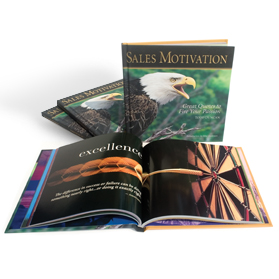
Sales motivation

If you’re in sales, I know you’ll use this often for that “shot of inspiration” to maintain a positive attitude. But, you don’t have to be in sales to love this book. If you like quotes and you like beautiful photos, well...this little book will “knock your socks off!”
Click here to turn the pages of this beautiful little book
Tuesday, February 05, 2008
How Sustainable Is Sustainability in a For-Profit Organization?
What Do You Think?
http://hbswk.hbs.edu/item/5834.html
Online forum OPEN until February 27. For managers, sustainability can mean the integration and intersection of social, environmental, and economic responsibilities. The concept is admirable, says Jim Heskett, but does it also confuse managers entrusted with the bottom line? How should they make trade-offs? What do you think?
Thursday, January 31, 2008
How Canon Got Its Flash Back
- The Innovative Turnaround Tactics of Fujio Mitarai'
Author: Nikkei, translated by Mark Schreiber and Aaron Martin Cohen
ISBN: 0-470-82123-X
If there were prizes for clever book titles, How Canon Got Its Flash Back would certainly be short-listed for a Best Book Title Award. But behind the amusingly apt title there is the serious story of Canons recent roller coaster ride. The company was one of Japans great success stories in the 1980s, approached the brink of financial disaster in the 1990s, and then turned the business around to re-achieve global supremacy in the past few years. The key to this recent success has been the strong personal leadership of Canons President and CEO, Fujio Mitarai. - Keith Hall
This book discusses the East-West style management strategies of its current president Fujio Mitarai (nephew of the founder, Takeshi Mitarai) that have turned Canon into a winner despite an increasingly dreary global economy. Mitarai was chosen as one of the world's top 25 managers in 2001 by leading US magazine BusinessWeek. Since taking office in 1995, Mitarai was viewed as a model for executives of large corporation throughout the world.
More information
Monday, January 28, 2008
Pick the Right Box to Think In
Dan and Chip Heath make a point on the value of boundaries: "We're always told to think outside the box. But it's about time someone spoke up for the box. Because, paradoxically, thinking inside the box can spark creativity, not squelch it. It takes options off the table, but it also dramatically improves the chances that your team will hit the target. So maybe you don't need to think out of the box. Maybe you just need a new one to think in."
Like lines on the field, boxes can be constraints that focus and liberate our constructive choices in playing the great game of business. True empowerment remains freedom within limits, not total freedom. Not even CEOs are totally free to act--they have stakeholders and legal constraints that create the sandbox they play in. Help define the limits and focus of your people and then let them soar.
Read on ...
Like lines on the field, boxes can be constraints that focus and liberate our constructive choices in playing the great game of business. True empowerment remains freedom within limits, not total freedom. Not even CEOs are totally free to act--they have stakeholders and legal constraints that create the sandbox they play in. Help define the limits and focus of your people and then let them soar.
Read on ...
Thursday, January 24, 2008
Write a Creative Marketing Plan in 7 Sentences
Our Guerrilla Marketing coach explains the quickest way to create an effective marketing plan, plus 7 ways to ensure its success.
Read on ...
Read on ...
Saturday, January 12, 2008
Monday, January 07, 2008
Under What Influence?
What do executives consider when making a decision? What motivates an executive to get involved in one activity or initiative at the expense of another? Who does the executive look to for advice -- and who does he or she ignore? CCL's Pete Hammett reveals seven myths and paradoxes that influence today's senior leaders. (more...)
Tuesday, December 18, 2007
The Secrets of great groups
Personal leadership is one of the most studied topics in American life. Indeed, I have devoted a big chunk of my professional life to better understanding its workings. Far less studied -- and perhaps more important -- is group leadership. The disparity of interest in those two realms of leadership is logical, given the strong individualist bent of American culture. But the more I look at the history of business, government, the arts, and the sciences, the clearer it is that few great accomplishments are ever the work of a single individual.
Article continues
Article continues
Saturday, December 15, 2007
leadership quote
"Trust men and they will be true to you; treat them greatly and they will show themselves great."
Ralph Waldo Emerson
Wednesday, December 12, 2007
The Myth of "Elegant Reasoning"
(more...)Great leaders create great strategies, right?
Not so.
The reality is that compelling strategies are seldom created but rather discovered and enhanced by drawing on the shared experiences of many.
Friday, November 30, 2007
Leadership Success Tip
Leadership is a social function. It is the ability to make people listen to you, follow you, and respect you in the process. Respect cannot be demanded – it must be earned. Therefore, the more wisely and effectively you practise interpersonal skills, the more respect you will win.
Friday, October 19, 2007
Analyticals don't rule
(But They Do Ask Questions)
ANALYTICALS: GOOD TO THE LAST OBJECTION
Two questions.
Question #1: When was the last time you sat down and listed all the things that people suspect or misunderstand about your organization?
Question #2: Do you depend on statistics to make your case? Maybe you're keen to send out an annual appeal letter lavishly buttered with service stats? "Our dedicated staff of eight plus our 27 volunteers delivered 1,892 evening meals to 1,230 addresses in six counties, seven days a week, 52 weeks a year." The McDonald's approach: 22 trillion served.
Read the whole article
ANALYTICALS: GOOD TO THE LAST OBJECTION
Two questions.
Question #1: When was the last time you sat down and listed all the things that people suspect or misunderstand about your organization?
Question #2: Do you depend on statistics to make your case? Maybe you're keen to send out an annual appeal letter lavishly buttered with service stats? "Our dedicated staff of eight plus our 27 volunteers delivered 1,892 evening meals to 1,230 addresses in six counties, seven days a week, 52 weeks a year." The McDonald's approach: 22 trillion served.
Read the whole article
Saturday, October 13, 2007
Wikipedia in Pinstripes
Companies interested in tapping into the shared expertise of their workers—the wisdom of crowds writ for business—are looking towards models such as Wikipedia that encourage collaboration.
Can Wikipedia work in pinstripes?
Harvard Business School professor Andy McAfee has his doubts that a corporate encyclopedia would have much value. But the underlying wiki technology—basically an electronic document and repository where participants can throw out ideas, comment on the work of others, and share documents—has more promise.
McAfee and collaborator professor Karim R. Lakhani discuss their research into wikis and other collaboration tools for the enterprise.
Read the whole article: How wikipedia works
Can Wikipedia work in pinstripes?
Harvard Business School professor Andy McAfee has his doubts that a corporate encyclopedia would have much value. But the underlying wiki technology—basically an electronic document and repository where participants can throw out ideas, comment on the work of others, and share documents—has more promise.
McAfee and collaborator professor Karim R. Lakhani discuss their research into wikis and other collaboration tools for the enterprise.
Read the whole article: How wikipedia works
Tuesday, October 09, 2007
Quote for the week
"An empowered organization is one in which individuals have the knowledge, skill, desire, and opportunity to personally succeed in a way that leads to collective organizational success."
--Stephen R. Covey
More quotations at the Pivotal quotations pages
--Stephen R. Covey
More quotations at the Pivotal quotations pages
Saturday, October 06, 2007
Leading in Times of Transition
12 Leader Competencies: What It Takes In Times of Transition
For many leaders, managing the business and addressing the needs of workers are at odds. They ask, "How can I make the tough decisions if I have to focus on the emotions and concerns of my employees?" The answer isn't about choosing either the people or the business, according to CCL's Kerry Bunker. Instead, the answer lies in being authentic and building trust.
Article continues
For many leaders, managing the business and addressing the needs of workers are at odds. They ask, "How can I make the tough decisions if I have to focus on the emotions and concerns of my employees?" The answer isn't about choosing either the people or the business, according to CCL's Kerry Bunker. Instead, the answer lies in being authentic and building trust.
Article continues
Wednesday, October 03, 2007
Ego in leaderhip
Are You an Egomaniac? Guy Kawasaki's Ten Questions with Steven Smith
Steven Smith has spent the past ten years exploring how great leaders use ego differently than everyone else—how they work, think, collaborate, and who they are.
Read on ...
Steven Smith has spent the past ten years exploring how great leaders use ego differently than everyone else—how they work, think, collaborate, and who they are.
Read on ...
Sunday, September 30, 2007
Just for fun - Dilbert's words of Wisdom n the corporate world
Dilbert's Words of Wisdom
Poor Dilbert (the cartoon character, for any who aren't familiar with him) has a cynical attitude, but often knows exactly what's going on and where the truth is buried.
Here are a few nuggets of wisdom from the Corporate World. Enjoy!
I can only please one person per day. Today is not your day. Tomorrow is not looking good either.
I love deadlines. I especially like the whooshing sound they make as they go flying by.
Accept that some days you are the pigeon and some days the statue.
Needing someone is like needing a parachute. If he isn't there the first time, chances are you won't be needing him again.
On the keyboard of life, always keep one finger on the escape key.
Don't be irreplaceable -- if you can't be replaced, you can't be promoted.
After any salary raise, you will have less money at the end of the month than you did before.
When bosses talk about improving productivity, they are never talking about themselves.
If at first you don't succeed, try again. Then quit, and remove all evidence that you tried. No use being a damn fool about it.
You are always doing something marginal when the boss drops by your desk.
If it wasn't for the last minute, nothing would get done.
When you don't know what to do, walk fast, carry a clipboard, and look worried.
You can find this item and lots more at the Pivotal Fun pages
Poor Dilbert (the cartoon character, for any who aren't familiar with him) has a cynical attitude, but often knows exactly what's going on and where the truth is buried.
Here are a few nuggets of wisdom from the Corporate World. Enjoy!
I can only please one person per day. Today is not your day. Tomorrow is not looking good either.
I love deadlines. I especially like the whooshing sound they make as they go flying by.
Accept that some days you are the pigeon and some days the statue.
Needing someone is like needing a parachute. If he isn't there the first time, chances are you won't be needing him again.
On the keyboard of life, always keep one finger on the escape key.
Don't be irreplaceable -- if you can't be replaced, you can't be promoted.
After any salary raise, you will have less money at the end of the month than you did before.
When bosses talk about improving productivity, they are never talking about themselves.
If at first you don't succeed, try again. Then quit, and remove all evidence that you tried. No use being a damn fool about it.
You are always doing something marginal when the boss drops by your desk.
If it wasn't for the last minute, nothing would get done.
When you don't know what to do, walk fast, carry a clipboard, and look worried.
You can find this item and lots more at the Pivotal Fun pages
Thursday, September 27, 2007
Six Sanity-Saving Scenarios to Turn a Massive Breakdown into a Powerful Business Breakthrough
There I was. Depressed, frustrated, and overwhelmed. Despite my best efforts to have a smooth running ship and organize my event, I realized I had a significant breakdown in my process. I admit, it wasn’t the end of the world, but come on, I teach this stuff!
It was one week before we went live on our new program, we were preparing the workbooks for production, and I realized, no one ordered the right tabs! Yikes!
It got me thinking how a client of mine had shared a great story about their direct mail marketing campaign. A lot of money had been invested in buying a list of qualified candidates. But every step of the way there was breakdown in the process – the guy who formatted the list didn’t set it up right, the assistant didn’t have the proper envelopes, and they had no postage when they needed it. My client laughed as he told me this, but I knew he was frustrated!
Well, I’ve learned over the years that a breakdown means that something very valuable is happening – I have new insight into how I can improve my process, my attitude, or my belief so that problem never happens again.
Let’s look at a few examples of how breakdowns can occur in our business or life.
Sunday, September 23, 2007
Overcoming shyness to become an excellent leader
"Don't let timidity stop you from being an excellent leader. Get over your shyness and get your company on the path to success."
People skills are so important in management, whether you are managing a business or a community organisation. As usual Stever Robbins has the problem and its solution in a nutshell ...
"Q: I am very shy, but very ambitious. I started a company and am up to four employees. I spend much of my time in my office because it makes me uncomfortable to spend too much time being social and having meaningless conversations. I don't think this is a good character trait. How can I become more comfortable around people?
A: Bravo for addressing this now! As your company grows, people will look to you for leadership. Literally. They'll watch how you act on a day-to-day basis and will adjust their tone accordingly. Conversation from the boss, even if it's idle chit-chat, isn't meaningless. It creates culture and lets people know how to respond.
Here's one thing I can guarantee: If you stay in your office, they won't think you're shy."
Read the whole article
People skills are so important in management, whether you are managing a business or a community organisation. As usual Stever Robbins has the problem and its solution in a nutshell ...
"Q: I am very shy, but very ambitious. I started a company and am up to four employees. I spend much of my time in my office because it makes me uncomfortable to spend too much time being social and having meaningless conversations. I don't think this is a good character trait. How can I become more comfortable around people?
A: Bravo for addressing this now! As your company grows, people will look to you for leadership. Literally. They'll watch how you act on a day-to-day basis and will adjust their tone accordingly. Conversation from the boss, even if it's idle chit-chat, isn't meaningless. It creates culture and lets people know how to respond.
Here's one thing I can guarantee: If you stay in your office, they won't think you're shy."
Read the whole article
Thursday, September 20, 2007
Hot Auction Prizes or Only In America!
Our friends from the US group Auctionpay (who kindly brought us the charity auction kit!) are reporting on the very latest hot auction items that are bringing in the big bucks at charity functions around the States.
And well the new 'trends' are eye openers!
According to the Auctionpay clients it seems the hottest items this year were medical services.
And well the new 'trends' are eye openers!
According to the Auctionpay clients it seems the hottest items this year were medical services.
Sunday, September 16, 2007
Raising the Bar: The Role of 'Social Information' in Charitable Giving
Suppose you work at an organization -- like a public radio station or public library -- that is about to launch a fund-raising drive to help cover operating expenses. How would you structure that drive? Are there ways to increase the amount of money that individual donors commit?
Wharton operations and information management professor Rachel Croson and a co-author set out to answer this question by examining the influence of social information on contribution behavior.
Their goal was to find out whether donors to a public radio station will give more money if they are told the amount of another donor's contribution.
The researchers present their findings in a paper entitled, "Field Experiments in Charitable Contributions: The Impact of Social Influence on the Voluntary Provision of Public Goods."
Read the whole article
More on fundraising
Wharton operations and information management professor Rachel Croson and a co-author set out to answer this question by examining the influence of social information on contribution behavior.
Their goal was to find out whether donors to a public radio station will give more money if they are told the amount of another donor's contribution.
The researchers present their findings in a paper entitled, "Field Experiments in Charitable Contributions: The Impact of Social Influence on the Voluntary Provision of Public Goods."
Read the whole article
More on fundraising
Saturday, September 08, 2007
When leadership becomes a quest
[From the ezine of Leadership Wired]
The head of one of the nation's largest credit card issuers learned many lessons in a previous career as a management consultant that he now has the opportunity to apply in his own company.
Richard Fairbank, the chairman, president and CEO of Capital One Financial, shared some of these principles at a recent talk at the Wharton School (of the University of Pennsylvania). Knowledge@Wharton, the b-school's bi-weekly online resource, provided the following highlights in an article titled When Leadership Becomes a Quest.
People are your business's most important asset. "You can't find anybody in corporate America who doesn't agree with this, but their actions are inconsistent with that statement," Fairbank told his audience. An important part of a CEO's job—as well as that of any other leader—is recruiting and motivating employees.
Cast a compelling vision, but don't allow your desire to overshadow your humanity. People are more likely to work hard for and cooperate with leaders who are authentic. Fairbank says this involves "being vulnerable, being honest and showing your weaknesses as well as your bold dream."
Success isn't about an impressive title or large paycheck. Rather, "It's about having a dream, a quest," Fairbank said. "[My father] used to say that, 'It doesn't matter how big the quest is. What matters is how pure the quest is. You can own your own success by virtue of defining it as a quest.'"
People who work in a specific industry often don't see, or respond to, the changes taking place around them, according to Richard Fairbank, chairman, president and CEO of Capital One Financial. That's because the industry's conventional wisdom is so embedded in their brains that they don't notice how stale it has become. "There's an old Will Rogers saying that sums it up," said Fairbank, who gave a talk on leadership this fall at Wharton. "It ain't what he don't know that scares me. It's what he knows that just ain't so."
Read more of the article Registration is free.
The head of one of the nation's largest credit card issuers learned many lessons in a previous career as a management consultant that he now has the opportunity to apply in his own company.
Richard Fairbank, the chairman, president and CEO of Capital One Financial, shared some of these principles at a recent talk at the Wharton School (of the University of Pennsylvania). Knowledge@Wharton, the b-school's bi-weekly online resource, provided the following highlights in an article titled When Leadership Becomes a Quest.
People are your business's most important asset. "You can't find anybody in corporate America who doesn't agree with this, but their actions are inconsistent with that statement," Fairbank told his audience. An important part of a CEO's job—as well as that of any other leader—is recruiting and motivating employees.
Cast a compelling vision, but don't allow your desire to overshadow your humanity. People are more likely to work hard for and cooperate with leaders who are authentic. Fairbank says this involves "being vulnerable, being honest and showing your weaknesses as well as your bold dream."
Success isn't about an impressive title or large paycheck. Rather, "It's about having a dream, a quest," Fairbank said. "[My father] used to say that, 'It doesn't matter how big the quest is. What matters is how pure the quest is. You can own your own success by virtue of defining it as a quest.'"
People who work in a specific industry often don't see, or respond to, the changes taking place around them, according to Richard Fairbank, chairman, president and CEO of Capital One Financial. That's because the industry's conventional wisdom is so embedded in their brains that they don't notice how stale it has become. "There's an old Will Rogers saying that sums it up," said Fairbank, who gave a talk on leadership this fall at Wharton. "It ain't what he don't know that scares me. It's what he knows that just ain't so."
Read more of the article Registration is free.
Wednesday, September 05, 2007
The role of the newsletter in your fundraising
Steve Hitchcock discusses the role of the newsletter in your organization's fundraising:
"Publishing a newsletter at least four times a year is essential if your organization is serious about raising money through the mail. Even with web pages and on-line newsletters, almost all of those who send contributions to nonprofit groups prefer -- desire -- to receive a paper newsletter in the mail.
Your newsletter doesn't have to be fancy. In fact, your donors will appreciate a simple, easy-to-read publication. The advantage of a four-page newsletter (or eight-pages with lots of photos) is that your donors will read it right away. Anything more substantial and they'll set it aside to read later. And you know what happens then."
Read the whole article
"Publishing a newsletter at least four times a year is essential if your organization is serious about raising money through the mail. Even with web pages and on-line newsletters, almost all of those who send contributions to nonprofit groups prefer -- desire -- to receive a paper newsletter in the mail.
Your newsletter doesn't have to be fancy. In fact, your donors will appreciate a simple, easy-to-read publication. The advantage of a four-page newsletter (or eight-pages with lots of photos) is that your donors will read it right away. Anything more substantial and they'll set it aside to read later. And you know what happens then."
Read the whole article
Monday, August 27, 2007
Selecting the Best Manager
When filling a management position, should you promote from within or hire an outsider?
Our expert weighs the pros and cons.
Hiring management-level employees can often be a daunting task. Of course, the major challenge is to select the individual who'll best fit into both the position and your business's culture. Before considering any candidates, however, your first decision is to determine whether you should promote internally or hire externally.
This article presents the pros and cons of each choice.
There are five good reasons why you might want to consider hiring an internal candidate.
First, it sets a precedent and second, it's good for morale. Employees are often very pleased when they see that "one of their own" has been promoted to a management-level position. And when morale goes up, productivity most often follows, especially when the employees like or respect the newly promoted individual.
Article continues
Our expert weighs the pros and cons.
Hiring management-level employees can often be a daunting task. Of course, the major challenge is to select the individual who'll best fit into both the position and your business's culture. Before considering any candidates, however, your first decision is to determine whether you should promote internally or hire externally.
This article presents the pros and cons of each choice.
There are five good reasons why you might want to consider hiring an internal candidate.
First, it sets a precedent and second, it's good for morale. Employees are often very pleased when they see that "one of their own" has been promoted to a management-level position. And when morale goes up, productivity most often follows, especially when the employees like or respect the newly promoted individual.
Article continues
Sunday, August 19, 2007
Meeting Success Tip
You can make use of confrontation. Turn it around. Approach it without apologies, avoid emotional involvement and use facts. Then turn it into a joint problem solving exercise.
More on meeting success.
More on meeting success.
Thursday, August 16, 2007
Don't allow phones in a meeting room
[From Robyn Pearce]
A very large international IT company asked for a course on 'How to run effective meetings'. It was the weirdest session I've ever run; a brilliant example of how not to run meetings. The trouble was, the CEO had a different work ethic to the rest of the company.
She'd been sent to Australia from the States to do the job, and had no family in the country. Her work was her life and she expected her managers to behave in the same way.
The session was a bun fight! People came and went like yoyos, phones rang constantly, and although everyone had chosen to come, the activities of a number of the group were so (unintentionally) disruptive that it minimised the learning
of the rest.
Tuesday, August 14, 2007
Look out Below
On April 14, 1912, a luxury ocean liner on its maiden voyage struck an iceberg in the North Atlantic and sank within hours, sending some 1,500 people to cold, watery graves.
The Titanic tragedy has been memorialised and analysed in movies, books and historical exhibits.
As anyone who saw James Cameron's 1997 blockbuster movie about this event can attest, the story is full of great human drama. From a leadership perspective, however, what really interests me is the iceberg.
Article continues
The Titanic tragedy has been memorialised and analysed in movies, books and historical exhibits.
As anyone who saw James Cameron's 1997 blockbuster movie about this event can attest, the story is full of great human drama. From a leadership perspective, however, what really interests me is the iceberg.
Article continues
Friday, August 10, 2007
Leadership success tip
We must always be alert to the problems team members may cause, and their weaknesses. But the strength of the team and its leader will be based on the ability to also see the best value in each other. We must not waste that value. And as individuals, we will always rise to the best value people see in us.
For free articles on Leadership, visit the Pivotal Leadership pages
For free articles on Leadership, visit the Pivotal Leadership pages
Friday, August 03, 2007
Pivotal Leadership Point
On the eve of his first inauguration, George Washington is reported to have said "Integrity and firmness are all I can promise."
Before you can have integrity, you must have firm values. It is important that you establish a basis of conduct from which to operate. Without a firm knowledge of what to you is right, and what to you is wrong, you will be indecisive in leadership situations. You must have a clear-cut standard of behaviour to guide your thought and actions in order to hold firmly to your integrity.
Before you can have integrity, you must have firm values. It is important that you establish a basis of conduct from which to operate. Without a firm knowledge of what to you is right, and what to you is wrong, you will be indecisive in leadership situations. You must have a clear-cut standard of behaviour to guide your thought and actions in order to hold firmly to your integrity.
Tuesday, July 31, 2007
Marketing - Do People Really Care How Long You've Been in Business?
Some marketing consultants talk about how you should always stress benefits, and never talk about features … and how you should always focus on the customer, and never on the company.
But is that always true? Of course not. For instance, the number of years you’ve been in business is a feature – a fact about the company. Yet prospects care how long you’ve been in business -- and your longevity can help close the sale.
Why?
Read on ...
But is that always true? Of course not. For instance, the number of years you’ve been in business is a feature – a fact about the company. Yet prospects care how long you’ve been in business -- and your longevity can help close the sale.
Why?
Read on ...
Saturday, July 14, 2007
Meeting Success Tip
If you want everyone's opinion, take note of those who have said nothing. When everyone is quiet, ask those people for their ideas.
Learn from our free set of tips on Using an agenda for meeting success. Ask for them now.
Learn from our free set of tips on Using an agenda for meeting success. Ask for them now.
Thursday, July 05, 2007
Blake Mouton Managerial GridBalancing Task - and People-Oriented Leadership
When your boss puts you in charge of organizing the company Christmas party, what do you do first? Do you develop a time line and start assigning tasks or do you think about who would prefer to do what and try to schedule around their needs?
When the planning starts to fall behind schedule, what is your first reaction? Do you chase everyone to get back on track, or do you ease off a bit recognizing that everyone is busy just doing his/her job, let alone the extra tasks you’ve assigned?
Your answers to these types of questions can reveal a great deal about your personal leadership style. Some leaders are very task-oriented; they simply want to get things done. Others are very people-oriented; they want people to be happy. And others are a combination of the two.
If you prefer to lead by setting and enforcing tight schedules, you tend to be more production-oriented (or task-oriented). If you make people your priority and try to accommodate employee needs, then you’re more people-oriented ...
Read on ...
When the planning starts to fall behind schedule, what is your first reaction? Do you chase everyone to get back on track, or do you ease off a bit recognizing that everyone is busy just doing his/her job, let alone the extra tasks you’ve assigned?
Your answers to these types of questions can reveal a great deal about your personal leadership style. Some leaders are very task-oriented; they simply want to get things done. Others are very people-oriented; they want people to be happy. And others are a combination of the two.
If you prefer to lead by setting and enforcing tight schedules, you tend to be more production-oriented (or task-oriented). If you make people your priority and try to accommodate employee needs, then you’re more people-oriented ...
Read on ...
Thursday, June 21, 2007
Good to Great: Why Some Companies Make the Leap… and Others Don’t
Good to Great: Why Some Companies Make the Leap… and Others Don’t
by Jim Collins
Collins and his team of researchers began their quest by sorting through a list of 1,435 companies, looking for those that made substantial improvements in their performance over time.
They finally settled on 11–including Fannie Mae, Gillette, Walgreens, and Wells Fargo–and discovered common traits that challenged many of the conventional notions of corporate success.
Making the transition from good to great doesn’t require a high-profile CEO, the latest technology, innovative change management, or even a fine-tuned business strategy. At the heart of those rare and truly great companies was a corporate culture that rigorously found and promoted disciplined people to think and act in a disciplined manner.
Peppered with dozens of stories and examples from the great and not so great, the book offers a well-reasoned road map to excellence that any organization would do well to consider.
Like Built to Last, Good to Great is one of those books that managers and CEOs will be reading and rereading for years to come. –Harry C. Edwards
From Publishers Weekly
After establishing a definition of a good-to-great transition that involves a 10-year fallow period followed by 15 years of increased profits, Collins’s crew combed through every company that has made the Fortune 500 (approximately 1,400) and found 11 that met their criteria, including Walgreens, Kimberly Clark and Circuit City.
At the heart of the findings about these companies’ stellar successes is what Collins calls the Hedgehog Concept, a product or service that leads a company to outshine all worldwide competitors, that drives a company’s economic engine and that a company is passionate about.
While the companies that achieved greatness were all in different industries, each engaged in versions of Collins’s strategies. While some of the overall findings are counterintuitive (e.g., the most effective leaders are humble and strong-willed rather than outgoing), many of Collins’s perspectives on running a business are amazingly simple and commonsense.
This is not to suggest, however, that executives at all levels wouldn’t benefit from reading this book; after all, only 11 companies managed to figure out how to change their B grade to an A on their own.
Thursday, June 14, 2007
GOOD THINKING
If you watched the swimming events at the ... Olympics last summer, you probably observed the incredible focus the medalists demonstrated.
Sure, they're strong and fast. But when hundredths - maybe even thousandths - of a second are all that separate the winners from the losers, it's obvious that something besides strength and speed is at work.
A comment by Flip Darr, a former collegiate swimming coach who played a part in training eight Olympic medallists, sheds some light on what that critical ingredient might be.
"I felt in my coaching career that if I would work on [the swimmers'] head[s], their bodies would come along," he said. "A lot of coaches work on their bodies and then at the last moment try to do their heads. The thing is, if they are working with their heads all the time, and working with their head over the body, mind over matter, they will have more confidence when they walk up to the block."
What a great illustration of the value of good thinking.
Athletic ability is important, but preparing for the biggest race of one's life is as much mental as it is physical - if not more so.
As Bill MacCartney, the former head football coach at the University of Colorado, once told me, "Mental is to physical what four is to one."
That's a powerful argument in the case for good thinking - on the football field, as well as in your office at work. The specific thoughts that increase your effectiveness as a leader might not be the same as those required for an Olympic medal, but the overall commitment to thinking is identical.
Click here to read the complete article
Sure, they're strong and fast. But when hundredths - maybe even thousandths - of a second are all that separate the winners from the losers, it's obvious that something besides strength and speed is at work.
A comment by Flip Darr, a former collegiate swimming coach who played a part in training eight Olympic medallists, sheds some light on what that critical ingredient might be.
"I felt in my coaching career that if I would work on [the swimmers'] head[s], their bodies would come along," he said. "A lot of coaches work on their bodies and then at the last moment try to do their heads. The thing is, if they are working with their heads all the time, and working with their head over the body, mind over matter, they will have more confidence when they walk up to the block."
What a great illustration of the value of good thinking.
Athletic ability is important, but preparing for the biggest race of one's life is as much mental as it is physical - if not more so.
As Bill MacCartney, the former head football coach at the University of Colorado, once told me, "Mental is to physical what four is to one."
That's a powerful argument in the case for good thinking - on the football field, as well as in your office at work. The specific thoughts that increase your effectiveness as a leader might not be the same as those required for an Olympic medal, but the overall commitment to thinking is identical.
Click here to read the complete article
Sunday, August 20, 2006
Thursday, August 17, 2006
Non profit communication
Put blogs to work as part of your communications strategy. A blog can help nonprofits communicate information to members in real time through frequent, brief entries on your organization's Web site.
Nancy E. Schwartz, Editor and Publisher, Getting Attention
From the Nonprofit Good Practice Guide
Tag: Non-profit
Nancy E. Schwartz, Editor and Publisher, Getting Attention
From the Nonprofit Good Practice Guide
Tag: Non-profit
Tuesday, August 15, 2006
Nonprofit Networking: The New Way to Grow
Author: Martha Lagace
Executive Summary:
How can a nonprofit increase its social impact? Many would say it needs to grow big to be strong. Instead, says HBS professor Jane Wei-Skillern, the answer could be in the power of strategic networks.
...................
Whether their mission is to protect wildlife, help disabled people, or offer financial services in developing countries, nonprofit organizations often believe they need to grow big before they can achieve significant social impact.
HBS professor Jane Wei-Skillern has been exploring something different: Her research suggests that a more powerful lever to increase a nonprofit's social impact might be to focus on building network relationships like-minded groups—even competitors. Read on ...
Executive Summary:
How can a nonprofit increase its social impact? Many would say it needs to grow big to be strong. Instead, says HBS professor Jane Wei-Skillern, the answer could be in the power of strategic networks.
...................
Whether their mission is to protect wildlife, help disabled people, or offer financial services in developing countries, nonprofit organizations often believe they need to grow big before they can achieve significant social impact.
HBS professor Jane Wei-Skillern has been exploring something different: Her research suggests that a more powerful lever to increase a nonprofit's social impact might be to focus on building network relationships like-minded groups—even competitors. Read on ...
Sunday, August 13, 2006
Quote
"No matter how much work a man can do, no matter how engaging his personality may be, he will not advance far in business if he cannot work through others."-- John Craig
Tag: Leadership
Tag: Leadership
Saturday, August 12, 2006
Executive Intelligence: What All Great Leaders Have

(Hardcover) by Justin Menkes
The final word on what traits make for highly successful managers - and a detailed explanation of how to identify potential standout performers. Executive Intelligence is about the substance behind great leadership.
Inspired by the work of Peter Drucker and Jim Collins, Justin Menkes set out to isolate the qualities that make for the 'right' people. Drawing on his background in psychology and bolstered by interviews with accomplished CEOs, Menkes paints the portrait of the ideal executive.
In a sense, Menkes's work reveals an executive IQ - the cognitive skills necessary in order to excel in senior management positions. Star leaders readily differentiate primary priorities from secondary concerns; they identify flawed assumptions; they anticipate the different needs of various stakeholders and how they might conflict with one another; and they recognise the underlying agendas of individuals in complex exchanges.
Weaving together research, interviews and the results of his own proprietary testing, Menkes exposes one of the great fallacies of corporate life, that hiring and promotion are conducted on a systematic or scientific basis that allows the most accomplished to rise to their levels of optimal responsibility. Finally, Menkes is a passionate advocate for finding and employing the most talented people, especially those who may have been held back by external assumptions.
"Executive Intelligence offers real insights into what differentiates the great leaders from the pack."
Kevin Sharer: Chairman, President & CEO of Amgen, Inc
"Executive Intelligence" is a breakthrough."
Noel M. Tichy, Professor, The Ross School, University of Michigan and author of Cycle of Leadership
"This will transform the way companies hire, promote and evaluate senior-level employees. It is nothing less than a revolution."
James M. Citrin, board director and practice leader, Spencer Stuart, and coauthor of the national bestsellers The 5 Patterns of Extraordinary Careers and You’re in Charge, Now What
"Justin Menkes has provided a useful guide for helping to identify the people you want to bet your company on."
Ed Breen, Chairman & CEO, Tyco International Ltd.
"Menkes offers a stimulating analysis of an important topic."
BusinessWeek
Amazon from $13.94Find in a library
Find in an Australian library
executive intelligence, leadership
Thursday, August 10, 2006
Meeting Success Tip for the Week
The mover of a motion does not have to vote for it. Putting a motion on the floor is a techniqe to facilitate control of discussion and to focus the meeting on making that discussion productive.
Tag: meetings
Tag: meetings
Tuesday, August 08, 2006
Fundraising idea - button making machines
Button Making Machines - Make Buttons for Cash
Back when I was in junior high I was in a computer club and as part of that club we used this button machine to make money. While we weren’t very creative at the time in what we put on buttons, the idea is a good one. People like to wear around buttons that say funny things.
fundraising
Back when I was in junior high I was in a computer club and as part of that club we used this button machine to make money. While we weren’t very creative at the time in what we put on buttons, the idea is a good one. People like to wear around buttons that say funny things.
fundraising
Sunday, August 06, 2006
Force For Change: How Leadership Differs from Management

Force For Change: How Leadership Differs from Management (Hardcover) by John P. Kotter
Leadership, Kotter clearly demonstrates, is for the most part not a god-like figure transforming subordinates into superhumans, but is in fact a process that creates change -- a process which often involves hundreds or even thousands of "little acts of leadership" orchestrated by people who have the profound insight to realize this. Building on his landmark study of 15 successful general managers, Kotter presents detailed accounts of how senior and middle managers in major corporations, in close concert with colleagues and subordinates, were able to create a leadership process that put into action hundreds of commonsense ideas and procedures that, in combination with competent management, produced extraordinary results.
John Kotter demythologizes the concept of leadership and clearly distinguishes it from management. In the process, he provides new guidelines for leaders and managers trying to optimize their relationships and effectiveness.
William H. Genge
Chairman, Ketchum Communications, Inc.
Full of powerful, useful ideas that will be of great service to those who have been struggling to define and assess leadership.
Thomas J. Mithen
General Electric
One not only learns from his book, but is excited by it. The weaving of research results and case examples is extremely effective.
Warren R. Wilhelm
AMOCO Corporation
More reviews at Aamzon where the book is selling for $21.95 new.
Saturday, August 05, 2006
How Important Is "Executive Intelligence" for Leaders?
In response to the ninety-seven online comments to this month's question, it appears that Justin Menkes, author of the book Executive Intelligence, has tapped into a hot issue with his concern that the concept is underrated, under-measured, and under-experienced in the selection and development of leaders.
http://hbswk.hbs.edu/item/5449.html#forum-summary
leadership
http://hbswk.hbs.edu/item/5449.html#forum-summary
leadership
Thursday, August 03, 2006
DO YOU HAVE THE QUALITIES TO BE A GREAT LEADER?
Do you have the personal qualities to be a great leader?
Leaders have
1. Flexibility. Leaders must be able to adapt to change, and have their organisation able to do so too.
2. Judgement. To be able to make the right choice at the right time
3. Courage. Courage is based on belief in one’s decisions, the courage to make a choice and stand by it, or to adapt to changing situations, and new information
4. Knowledge. A leader needs to have the knowledge necessary to do the job – knowledge of the technical side of the organisation and of the people. That knowledge must be kept constantly up to date.
5. Will power. To stick with choices and decisions and to see them implemented. And to be able to stay flexible and responsive to all inputs.
6. Integrity. The foundation stone for all of these is integrity. We all respond to integrity
leadership
Leaders have
1. Flexibility. Leaders must be able to adapt to change, and have their organisation able to do so too.
2. Judgement. To be able to make the right choice at the right time
3. Courage. Courage is based on belief in one’s decisions, the courage to make a choice and stand by it, or to adapt to changing situations, and new information
4. Knowledge. A leader needs to have the knowledge necessary to do the job – knowledge of the technical side of the organisation and of the people. That knowledge must be kept constantly up to date.
5. Will power. To stick with choices and decisions and to see them implemented. And to be able to stay flexible and responsive to all inputs.
6. Integrity. The foundation stone for all of these is integrity. We all respond to integrity
leadership
Tuesday, August 01, 2006
Auction Tips - 5 Steps to Auction Success
There is no doubt about it; an auction takes a lot of work and commitment on many levels. Soliciting items for both the live and silent portion of the auction, also called procurement, is key to a profitable event. Putting together a powerful procurement team can help ensure success in securing donations and meeting event revenue goals. Whether this team is professional staff or a volunteer committee the same ideas apply.
The procurement team is a group of individuals who will be tasked with soliciting contributions for the auction. Ideally, the team will consist of people who have both the time and perseverance to contact potential vendors both by phone and in person for donations. Individuals who are both friendly and persuasive, and above all committed to your cause are most effective. It is also very helpful to engage members on your procurement team who are well connected in the community and have access to people with influence. Read on ...
The procurement team is a group of individuals who will be tasked with soliciting contributions for the auction. Ideally, the team will consist of people who have both the time and perseverance to contact potential vendors both by phone and in person for donations. Individuals who are both friendly and persuasive, and above all committed to your cause are most effective. It is also very helpful to engage members on your procurement team who are well connected in the community and have access to people with influence. Read on ...
Sunday, July 30, 2006
Meeting Success Tip for the Week:
Sit where you can be seen. Place yourself with the most powerful people, so you get the halo effect. If you are presenting, face them. Sit in the middle of the row, not the end, to maximise your contact with the other people at the meeting. At a table, sit the head of the table. These are external symbols of validation.
MEETINGS
MEETINGS
Saturday, July 29, 2006
Third Annual Nonprofit Forum: Strategies for Sustainability
8 September - 9 September
Transforming the nonprofit sector in the 21st century through adopting innovation
Aimed at the senior managers of nonprofit organisations, marcus evans third annual Nonprofit Forum looks beyond the traditional view of nonprofit as just 'fundraising organisations' and considers the strategic and operational leadership aspects that drive the performance of professional and responsible nonprofit companies.
This year, our leadership forum showcases a range of management issues with a focus on creating new efficiencies and accessing new markets and strategic business partnerships for successful sustainability.
Third Annual Nonprofit Forum (8th & 9th August, Sydney) offers an opportunity to hear best practice presentations and case studies, and participate in expert discussions addressing strategies for sustainability relevant only to the Third Sector.
You will benefit from an independent platform where you will learn by sharing with your peers and with key stakeholders within the Third Sector.
contact Chris Lowat marcus evans on 61(2) 9223 2137 or email:marketing@marcusevansau.com
For full programme, see:www.marcusevans.com.au/pdf/459.pdf
not for profit
Thursday, July 27, 2006
Cooperation
"Great discoveries and improvements invariably involve the cooperation of many minds. I may be given credit for having blazed the trail but when I look at the subsequent developments I feel the credit is due to others rather than to myself."-- Alexander Graham Bell
quotations
Tuesday, July 25, 2006
Leadership Success Tip
Do what needs to be done to ensure that the goals for your area of responsibility are clearly defined. Write them down, commit to them in a report, or use them to chart a course of ation. If they are flexible then the parameters and degree of flexibility also need to be clearly defined.
leadership
leadership
Sunday, July 23, 2006
Team Builder Tip: Results and Relationships
"Separate the People From the Problem" is the title of the second chapter of one of the best books ever written on conflict resolution, Getting to Yes
I use the concepts for team-building workshops because the best tactic ever for addressing conflict is to build solid relationships within the partnership, team, group, or organization. Proactivity pays off here. Read on ...
team building, leadership
I use the concepts for team-building workshops because the best tactic ever for addressing conflict is to build solid relationships within the partnership, team, group, or organization. Proactivity pays off here. Read on ...
team building, leadership
Saturday, July 22, 2006
Killing me softly - the conflict resolution conference
Preventing, negotiating and resolving conflict in your community organisation.
Friday 8th September 2006 ... 9-4.15
More information
conflict resolution
Friday 8th September 2006 ... 9-4.15
More information
conflict resolution
Thursday, July 20, 2006
Volunteer Management Training
Where: Sydney, Bathurst
When: 14 August 2006 - 16 August 2006
Start time: 9.00 amF
inish time: 4.00 pm
Effective Volunteer Management : Mobilising Your Resources
Join Rick Lynch, leading US Based volunteerism trainer and author for this challenging, stimulating and useful one day workshop.
Rick is a US based volunteer management expert, trainer and author. He has written numerous books on leadership, volunteer management and excellence in non-profit organisations, including co-authoring 'Volunteer Management : Mobilising All the resources of the Community'
The day will cover :
the four elements of jobs that are intrinsically motivating
how to really measure the impact of volunteer activity
how to stop micromanaging your volunteers
how to talk to volunteers who fail to meet your standard
volunteers
Tuesday, July 18, 2006
Motivate each person according to values!
From Stever Robbins
A friend just sent me this link about how to be a Technical Lead. It is written for technical people by a technical person, but it really applies to anyone running a company that depends on technologists.Especially note “Mistake #2,” which discusses motivation.
One of the most common things I’ve found is managers who don’t take the time to find out what is motivating to their particular people. They assume that everyone wants the same recognition they do. Or they assume everyone thinks a football outing is the be-all-and-end-all of bonding. Read on ...
leadership
Sunday, July 16, 2006
Nonprofit organizations are concerned
The cause (the people, places, things, or issues the organization wants to help or change)
Donors (the people and companies that contribute resources to help the cause)
Volunteers and helpers
The media
Each of these groups interacts with the nonprofit organization in its own unique way.
Subsequently, nonprofits need to develop their organizational personality in ways that they can develop meaningful relationships with these audiences.
One of the first tenets of Robin Hood Marketing is to not preach and evangelize about the cause or the organizational mission. Instead, take a page from the Nike marketing book and ask each group for a specific action. Read on ...
not for profits
Thursday, July 13, 2006
Know thyself . . . and thy donor
WITH THE proliferation of conferences on direct response fundraising, new techniques are being shared far and wide. But to Diane Bernardini, Direct Mail Manager for Maryknoll Fathers and Brothers (Maryknoll NY), there’s an important caveat:
“Sometimes you go to seminars and somebody will find something. And it’s almost like it’s too gimmicky. You have to be careful with those gimmicks. Because what works for somebody else may not work for you. And I think it’s important to know what your organization is, what kind of donors you’re looking for, and stay right on target.” Because, she adds, “with some gimmicks, you can end up getting donors, but they just won’t respond again.” Read on ...
fundraising
“Sometimes you go to seminars and somebody will find something. And it’s almost like it’s too gimmicky. You have to be careful with those gimmicks. Because what works for somebody else may not work for you. And I think it’s important to know what your organization is, what kind of donors you’re looking for, and stay right on target.” Because, she adds, “with some gimmicks, you can end up getting donors, but they just won’t respond again.” Read on ...
fundraising
Tuesday, July 11, 2006
Narcissism and Leadership: A Review and Research Agenda
By Seth A. Rosenthal
This article appeared in the 2006 issue of Working Papers
It is clear that a significant number of world leaders have rigidly grandiose belief systems and leadership styles. Often, the authors who recount the “psychohistories” of these leaders connect both the leaders’ assent to power, and their ultimate (and seemingly inevitable) downfall, to their narcissistic grandiosity.
While not every author employs the term “narcissism” to describe the leader in question, across the board they reliably depict individuals whose aspirations, judgments, and decisions, both good and bad, are driven by unyielding arrogance and self-absorption.
The pantheon of purportedly narcissistic leaders ranges from the great tyrants of recent history including Hitler, Stalin, and Saddam Hussein (Glad, 2002), to lesser-known malevolent leaders like the founder of the American Nazi Party, George Lincoln Rockwell (Miliora, 1995) and cult leader Jim Jones (Zee, 1980), great historical figures such as Alexander Hamilton (Chernow, 2004), business leaders of all stripes including Steve Jobs (Robins & Paulhus, 2001), Michael Eisner (Sankowsky, 1995), David Geffen (Kramer, 2003), and Kenneth Lay (Kramer, 2003), and an eclecticand sometimes surprising list of current political leaders such as Benjamin Netanyahu (Kimhi, 2001), John McCain (Renshon, 2001), George W. Bush (Krugman, 2005; Suskind, 2004), and both Jimmy Carter and his mother, Lillian (Glad & Whitmore, 1991).
Read the remainer of this article in PDF format »
leadership
This article appeared in the 2006 issue of Working Papers
It is clear that a significant number of world leaders have rigidly grandiose belief systems and leadership styles. Often, the authors who recount the “psychohistories” of these leaders connect both the leaders’ assent to power, and their ultimate (and seemingly inevitable) downfall, to their narcissistic grandiosity.
While not every author employs the term “narcissism” to describe the leader in question, across the board they reliably depict individuals whose aspirations, judgments, and decisions, both good and bad, are driven by unyielding arrogance and self-absorption.
The pantheon of purportedly narcissistic leaders ranges from the great tyrants of recent history including Hitler, Stalin, and Saddam Hussein (Glad, 2002), to lesser-known malevolent leaders like the founder of the American Nazi Party, George Lincoln Rockwell (Miliora, 1995) and cult leader Jim Jones (Zee, 1980), great historical figures such as Alexander Hamilton (Chernow, 2004), business leaders of all stripes including Steve Jobs (Robins & Paulhus, 2001), Michael Eisner (Sankowsky, 1995), David Geffen (Kramer, 2003), and Kenneth Lay (Kramer, 2003), and an eclecticand sometimes surprising list of current political leaders such as Benjamin Netanyahu (Kimhi, 2001), John McCain (Renshon, 2001), George W. Bush (Krugman, 2005; Suskind, 2004), and both Jimmy Carter and his mother, Lillian (Glad & Whitmore, 1991).
Read the remainer of this article in PDF format »
leadership
Sunday, July 09, 2006
Executives ‘On-Loan’ to Charities
For many Not for Profits, living from grant to grant and having no time for long term planning can lead to corporate envy – wondering how top company managers re-invigorate their operations.
So what about having an ‘executive-on-loan’?
That’s an idea that Melbourne Cares hopes to address in the future – where companies lend their executives to Not for Profit organisations for a year or longer and often at no charge to offer much-needed business experience. Read on ...
executives, not for profits
Saturday, July 08, 2006
Church Resources’ Specials for NFP’s
Need the buying power of a large organisation to reduce your costs?
Since 1997 Church Resources has been providing the strength of a large national buying group to help all Not for Profits save time and money.
Membership is free and all church and NFP groups are eligible to register and can benefit from savings and improved levels of service on a range of products from telecommunications and office equipment through to advertising, cars, travel and many more!
To take advantage of the specials below you must be a Church Resources member. To register visit www.churchresources.com.au/register.php
For more information on Church Resources and for a copy of our latest Savings Guide call 1300 CHURCH (1300 248 724) or visit www.churchresources.com.au
not for profit
Since 1997 Church Resources has been providing the strength of a large national buying group to help all Not for Profits save time and money.
Membership is free and all church and NFP groups are eligible to register and can benefit from savings and improved levels of service on a range of products from telecommunications and office equipment through to advertising, cars, travel and many more!
To take advantage of the specials below you must be a Church Resources member. To register visit www.churchresources.com.au/register.php
For more information on Church Resources and for a copy of our latest Savings Guide call 1300 CHURCH (1300 248 724) or visit www.churchresources.com.au
not for profit
Thursday, July 06, 2006
How Individual Power Use Affects Team Process and Performance: Implications for the Powerholder
By Ruth Wageman, Elizabeth Mannix
This article appeared in the 2006 issue of Working Papers
Even within teams of peers, certain individuals have more power than others. Individual members may have essential skills and experience, networks outside the team, or status within the organization that give them more power than the average team member (French & Raven, 1959; Hollander, 1958).
How these powerholders use their power may vary from team to team. For example, consider a task force whose purpose is to solve a problem in the organization’s ability to attract new members. One member of the team is especially expert in member-engagement practices and root cause analysis, upon which the team is dependent to complete its task well. This dependency gives her power (Emerson, 1964).
She might use her power solely to influence the team’s task approach in the areas most relevant to her particular skill. Or she may use her special influence to dominate a range of team functions, from managing relations with senior leaders, to controlling the conflict-management processes within the group. Or she might exert no special influence at all, acting as an average team member in all domains. What consequences might her choices have for the effectiveness of this team?
Read the remainer of this article in PDF format »
leadership, teams,
This article appeared in the 2006 issue of Working Papers
Even within teams of peers, certain individuals have more power than others. Individual members may have essential skills and experience, networks outside the team, or status within the organization that give them more power than the average team member (French & Raven, 1959; Hollander, 1958).
How these powerholders use their power may vary from team to team. For example, consider a task force whose purpose is to solve a problem in the organization’s ability to attract new members. One member of the team is especially expert in member-engagement practices and root cause analysis, upon which the team is dependent to complete its task well. This dependency gives her power (Emerson, 1964).
She might use her power solely to influence the team’s task approach in the areas most relevant to her particular skill. Or she may use her special influence to dominate a range of team functions, from managing relations with senior leaders, to controlling the conflict-management processes within the group. Or she might exert no special influence at all, acting as an average team member in all domains. What consequences might her choices have for the effectiveness of this team?
Read the remainer of this article in PDF format »
leadership, teams,
Tuesday, July 04, 2006
Premium treatment
By Mal Warwick
PREMIUMS are one of the most hotly debated topics in direct mail fundraising. Their advocates — and they’re many — insist that premiums routinely boost response rates by generous margins. The most enthusiastic of these folks assert that donors acquired through the use of premiums have long-term value no less than that of donors acquired without them. Read on ...
fundraising
PREMIUMS are one of the most hotly debated topics in direct mail fundraising. Their advocates — and they’re many — insist that premiums routinely boost response rates by generous margins. The most enthusiastic of these folks assert that donors acquired through the use of premiums have long-term value no less than that of donors acquired without them. Read on ...
fundraising
Sunday, July 02, 2006
Knowledge Nomads: Understanding an Overlooked Segment of the Workforce Helps Managers Lead
By Todd L. Pittinsky, Magaret J. Shih
This article appeared in the 2006 issue of Working PapersManagers have formal and official supervisory authority within an organizational hierarchy. As a result, a perennial concern of managers is employee mobility, i.e., the turnover of workers, and the implication of worker mobility for the staffing of critical functions in the organization.
Read the remainer of this article in PDF format »
managers, employment
This article appeared in the 2006 issue of Working PapersManagers have formal and official supervisory authority within an organizational hierarchy. As a result, a perennial concern of managers is employee mobility, i.e., the turnover of workers, and the implication of worker mobility for the staffing of critical functions in the organization.
Read the remainer of this article in PDF format »
managers, employment
Saturday, July 01, 2006
Rational sharing and its limits
People differ in their willingness to share, as well as their reasons to do so. An open collaboration community of willing sharing members thrives on a virtuous cycle: increased sharing often offers stronger reasons for more people to share. However, it may also decline when the cycle goes the opposite direction and turns vicious. What determines the dividing line?
We offer insights into this important question based on an analytic understanding of the concept of rational sharing, which is sharing for net gain in personal utility. In a nutshell, a community thriving on rational sharing is essentially an economic system, a platform for creating mutual benefit through exchanges.
This analysis is based on our prior work in statistical modelling of peer–to–peer systems. There are two salient features. First, the shared content is modelled as a mixture of different types of goods. Members’ sharing is pooled and organized into supply, which in turn is brought to match with demand from the members themselves, and a wider community also in the case of open access. The importance of the goodness of match between supply and demand is therefore apparent. Second, incentive schemes are modelled simply as dependence between the quality of service a member sees and the level of sharing. Being simplistic, it points to an interesting generic observation: no incentive is strong enough to break the catch–22 situation during startup unless some seed content is present.
We are not suggesting rationality as the only conscious basis of sharing for individuals. Quite the contrary, we gauge the limits of rational sharing thereby, and identify when and how non–rational bases of sharing is needed. For instance, high quality open access Wikis we witness today would not have been sustainable if sharing had been purely rational, as meaningful reward in quality gain has to be reserved for enticing rational members. Read on ...
community, sharing
We offer insights into this important question based on an analytic understanding of the concept of rational sharing, which is sharing for net gain in personal utility. In a nutshell, a community thriving on rational sharing is essentially an economic system, a platform for creating mutual benefit through exchanges.
This analysis is based on our prior work in statistical modelling of peer–to–peer systems. There are two salient features. First, the shared content is modelled as a mixture of different types of goods. Members’ sharing is pooled and organized into supply, which in turn is brought to match with demand from the members themselves, and a wider community also in the case of open access. The importance of the goodness of match between supply and demand is therefore apparent. Second, incentive schemes are modelled simply as dependence between the quality of service a member sees and the level of sharing. Being simplistic, it points to an interesting generic observation: no incentive is strong enough to break the catch–22 situation during startup unless some seed content is present.
We are not suggesting rationality as the only conscious basis of sharing for individuals. Quite the contrary, we gauge the limits of rational sharing thereby, and identify when and how non–rational bases of sharing is needed. For instance, high quality open access Wikis we witness today would not have been sustainable if sharing had been purely rational, as meaningful reward in quality gain has to be reserved for enticing rational members. Read on ...
community, sharing
Subscribe to:
Posts (Atom)

 Posts
Posts