In his book, “Sandbox Wisdom,” Tom Asacker has rewritten the rules on leadership and service. It is fun, refreshing and a terrific theme for any organization to encourage creativity and great service. It is quite possibly a life altering read. Click on the link below to read an excerpt from the book.
Sandbox wisdom
Friday, June 26, 2009
Leadership
As we prepare to celebrate Independence Day on July 4th we often reflect on the thoughts and sacrifices made by the leaders that have preceded us. Take a few minutes to enjoy the movie, “Great Quotes from Great Leaders,” which is filled with timeless wisdom from great leaders who have inspired, encouraged and led us to do the right thing.


Wednesday, June 17, 2009
How To Be A Masterful Manager

Being a successful manager requires many skills. It is not enough to be technically proficient at doing your job. This e-book by Australia's NO. 1 Productivity coach, Lorraine Pirihi has heaps of practical, easy-to-implement ideas to accelerate your leadership abilities and to help you be the best manager you can be.
How To Be A Masterful Manager
Sunday, June 14, 2009
Meetings and Road Trips
Managing a meeting is like setting off on a long car trip with friends or family. You need to plan your route, pay attention to the rules of the road, consider what will keep your passengers engaged and occupied, and always remember you have to get back home at the end.
Just as adults and children consider car trips to be tolerable as the only way to get to certain places, so too do business people view meetings as necessary evils.
Here are three ways to make an enormous difference in your meetings.
1. KNOW WHERE YOU'RE GOING
Most of us wouldn't start a trip through unfamiliar territory without looking at a map beforehand so we don't get lost. Preparation may be just ten minutes, but a little preparation goes a long way toward making a meeting successful. You want your time to be productive and efficient. Whether your meeting is with a five-person project team, 100 worldwide sales people, or an online multi-location group, you need to consider a few key items ahead of time.
• What is your desired outcome? If the meeting were over, and you were delighted with it, what would you have as a result? Do you want consensus on a course of action or new ideas on a recurring problem? Do you simply want updates on what everyone is doing? Once you're clear on what you want, you can state a clear Meeting Objective and share it with everyone at the meeting.
• Decide on the type of meeting. Most meetings have four possible activities: sharing information, collecting information, problem solving, and decision making. Many meetings are a mixture of these. For every agenda item, think ahead of time about what you want as an outcome. That will help you, and everyone else, know when you're on-topic and when you're not.
2. HONOR THE RULES OF THE ROAD AND MANAGE YOUR PASSENGERS
When you're in a car on a trip, the easy ways to ruin the experience are to get stopped by the police when you disobey the rules of the road or to have the passengers fighting and complaining. The same is true of meetings. Let people know what the guidelines are. Do your best to keep the dialogue moving forward. Listen to all viewpoints, but don't let one view dominate the others. Manage the time and discussion so that speakers change and participants are engaged. If you're bored, so are others. If you're tired of a particular voice, you're not alone. Use the following guidelines to keep the meeting lively.
• Be an effective chairperson. Be even-handed. Make and maintain good personal connection with your group. If you want active participation, avoid evaluating what people say until it's time to make a decision. Keep the information and dialogue flowing. And when you get to a decision point, say so publicly. State the decision (whether it's consensus or a decision to get more info or a selected course of action), then go on to the next steps on that decision or to the next topic.
• Manage airtime. Manage the meeting like a good traffic cop - give everyone his or her turn. Enforce brevity. If someone rambles on and on, paraphrase his or her point and then turn to someone else in the meeting. Draw out the quiet individuals.
• Handle conflict. The majority of conflict in meetings arises from misunderstanding between two or more people. Be sure each position is clearly articulated (without value judgments about opposing viewpoints) and understood.
3. END OF THE TRIP
There's something anti-climactic about getting home from a long car trip. The ride home seems endless when the anticipation is gone. This happens in meetings also. So end your meetings with a bang, not a whimper. Here's how:
• Finish on time. Honor the time commitment you made to participants. If you consistently end meetings later than promised, people will either make excuses not to attend your next one or find a reason to leave early.
• Identify next steps. A very frustrating aspect of meetings is the perception that nothing changes as a result of them. A way to ensure something indeed will happen is to identify and write down next steps - the agreed-upon actions to be taken after the meeting. Include what has to be done, by whom, and when. Do this on a flipchart or in some other visible way. And make sure attendees get the notes of the meeting.
• Finally, follow up on the next steps after the meeting. Let people know it matters that they were in the meeting. Check in. See how it's going. Ask if additional resources are needed. If appropriate, see if a follow-up meeting makes sense as a way to chart progress. Keep people informed.
Again, a little planning goes a long way in making meetings productive and even enjoyable. You probably already spend a lot of time now, clarifying decisions after the meeting or even trying to remember what decisions were made! Consider the cost of meetings when everyone leaves and remembers the tangents and not what actions will be taken. In this case, the meeting itself was ineffective and no one's behavior or subsequent action was changed. That's wasted time - a real dead end.
Peg Kelley, MBA, has been a professional facilitator for over 30 years. She has authored a booklet - 39 Secrets for Effective and Enjoyable Meetings - and publishes a newsletter of meeting management tips. Both are available at her website: http://www.meetingtoolsandjewels.com Kelley@facplus.com if you want to receive it.
Monday, June 08, 2009
How Organizations create social value
A recent study on the factors that contribute to successful high-performance social enterprises finds a connection between enterprises that link economic value with social value. ... more
Tuesday, June 02, 2009
What are the secrets of good leadership?

Find out from the people at the top. At this year's exclusive silicon.com CIO 50 event, the UK's leading CIOs revealed their top tips for leadership success.
Friday, May 29, 2009
Project Management Training - A Key To Profitable Organization
from George Purdy
We can broadly classify project management into project planning and managing the project as per the plan. Fine project management training should include sessions on resource planning, risk assessment methodologies, estimation techniques, schedule preparation and tracking, resource management. Training should take into account a proper balance between management and planning aspects of project management.
There are a lot of choices available to an organisation on providing project management training to it's workforce. One way is to develop internal trainers and training framework within the company. This type of in house training has the advantage of saving costs, giving flexibility on the training content. However it may take long time to reach a matured stage for the training framework.
One more alternative way is to use the services offered by professional training institutions, whose main objective is to provide professional training to business organizations. An organisation that doesn't have the needed resources to train the workforce in house, can take advantage of the services offered by these training institutions. This could save lot of time and energy. But these services may be very dear.
One of the useful ways is to have a good collection of management books in a company library.One such book which one can get hold of in management lierature is Training for profit: a guide to the integration of training in an organizations success.It explains the opportunities and the advantages that a person gets from workforce training and corelates them to the financial performance of the organization's.It also acts as a helpful guide to the internal trainers by helping them to know the innovative methods by which a workforce can be trained.
In order to successfully build a team and carry out a project, a number of soft skills are essential. These include communication skills, cross-cultural competence, interpersonal skills, the ability to negotiate and effective customer interaction. Project management training needs to incorporate these skills into its curriculum. Having a well-trained workforce is very important, and no organization should underestimate the impact it can have on profitability.
Training employees in project management helps organizations to achieve their predetermined objectives in executing projects. Areas of project management training include project planning, resource planning, risk assessment and estimation techniques and preparation and monitoring of schedules The training can be internal in order to save on costs and have flexibility in training content; or it can be given by external institutions, if the organization does not have in-house resources for training. Providing access to management books such as Training for Profit: A Guide to the Integration of Training in an Organizations Success is also a good alternative.
Saturday, May 16, 2009
Conducting effective meetings
An organization of any size requires meetings. Meetings help different people with different job responsibilities cooperate to complete projects and achieve objectives.
But as Peter Drucker noted, an abundance of meetings is a sign of a diseased organization. If you conduct effective meetings, they will become shorter and less frequent.
Here are a few guidelines for conducting effective meetings:
Tuesday, May 05, 2009
Silos, Politics and Turf Wars

A Leadership Fable About Destroying the Barriers That Turn Colleagues Into Competitors
by Patrick M. Lencioni
Lencioni addresses a serious problem facing most organizational leaders. A recent study by the American Management Association found 97% of executives believed `silos' have negative effects on organizations, 31% believed they have extensive destructive consequences, and 83% believed they existed in their companies.
Read more at http://www.pivotalpersonalbest.com/silos.htm
Monday, April 27, 2009
Leadership and change
The RapidBi blog has created a list of Nine Ways Leaders transform organisations .... Worth a look. Does "remove obstacles" really apply?
Tuesday, April 21, 2009
Hiring for Executive Intelligence
Hiring managers have all but ignored standard IQ, but they remain the best predictor of managerial success. Here is how to design an interview that uncovers executive intelligence. A Harvard Business Review excerpt. >>>
Wednesday, April 15, 2009
How to be a masterful manager
Is managing people a real headache for you? Do you wish they would use their initiative and just get the work done? Are you finding that ‘people problems’ are consuming your time?
Well it may not be their fault. It could well be that you need to learn how to be a masterful manager!
According to a recent survey by SEEK, the online job search company, 60% of employees said ‘the quality of management’ was what they hated most about their jobs.
Being a successful manager requires many skills. It is not enough to be good at what you do.
If you also happen to be the owner of the business, you’ll soon discover how important it is to ‘get it right’, otherwise you will lose a lot of time and money ensuring your employees are happy and productive.
Happy people are likely to be much more productive and profitable for your business, so it’s critical you get your act together.
As a manager, your key role is to manage people. This is a skill that needs to be learned and continually developed…and if you are prepared to invest time and money into being an effective manager you will enjoy the benefits of your efforts.
You’ll be happier, confident and in control. You’ll earn the respect of your people. They will also be happier and more effective due to your leadership abilities. Good leaders will be able to maintain a high performing team... and a great leader will attract great people.
“How to Be a Masterful Manager “ has heaps of practical, easy-to-implement ideas to accelerate your leadership abilities and to help you be the best manager you can be.
In this powerful e-book you will discover:
How To Organise Yourself So You Have Time To Do Your Own Work As Well As Effectively Manage Your Team
Why The Way You Dress Impacts On Your Success As A Leader And How You Can Dress For Success.
The Benefits Of Having A Personal Assistant And How To Work Effectively Together
How To Look After Your People So They Look After Your Business
How To Have Productive Meetings And Achieve Results
How To Save Time, Money And Your Sanity By Learning To Communicate With The Opposite Sex
How To Avoid Procrastination And Just Get On With It
Your No. 1 Asset Is You And By Continuing To Develop Yourself, Your Results in Both Your Business And Work Life Will Go Through The Roof Invest now!
Saturday, April 11, 2009
A Top Executive Job Never Comes with a Roadmap
Most people are promoted to positions of leadership based on their accomplishments as an individual contributor. As they continue to move up the ranks through the years that follow, absent any significant focus on developing themselves as leaders, their outmoded tactics and strategies for “leading” become liabilities—or at least fail to act as the assets they could be—and their performance is less than stellar. Call it the law of self-inflicted diminishing returns.
http://leadershipunleashed.typepad.com/leadership/2009/02/a-top-executive-job-never-comes-with-a-roadmap.html
Wednesday, April 08, 2009
The Six C's of leadership
Unsurprisingly, the need for leadership today is more important than ever before. Rafael Pastor, the ex-President of USA Networks and current CEO of Vistage International, and Barry Sternlicht, the ex-CEO of Starwood Hotels and current head of Starwood Capital Group, both had some astute comments on the subject. Coincidentally, and surprisingly, both of them summarized their perspectives with concepts beginning with a “C”, so it’s really easy to combine their viewpoints and come up with a "C" list of leadership attributes necessary for success in the 21st century. I wish I had enough poetry to come up with this list, but at least I can use my own words in describing the six elements:
... more
... more
Saturday, April 04, 2009
Video - Managing organisation change

Michael delivers a 3-step method for managing organizational change that he has used effectively in organizations to lead change and build strong teams.
Sunday, March 29, 2009
Getting serious about your meeting problem
Getting serious about your meeting problem
Do you have one? Some folks are going to eight hours of meeting a day. At Ford, they used to have meetings to prepare for meetings, just to be sure everyone had their story straight.
If you're serious about solving your meeting problem, getting things done and saving time, try this for one week. If it doesn't work, I'll be happy to give you a full refund.
Thursday, March 26, 2009
Why your Employees are Losing Motivation
Business literature is packed with advice about worker motivation—but sometimes managers are the problem, not the inspiration. Here are seven practices to fire up the troops.
... more
... more
Friday, March 20, 2009
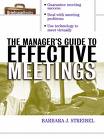
Book The Manager's Guide to Effective Meetings

by Barbara J. Streibel
In our increasingly collaborative work environment, the ability to manage results-driven meetings has become a critical career asset. Let The Manager's Guide to Effective Meetings provide you with a step-by-step template for energizing your next meeting, and transforming it from a roomful of clock-watching individuals into a collaboration of involved and enthusiastic partners.
(more ...)
Wednesday, March 18, 2009
Operating With 20/20 Vision in Areas That Matter Most
A father and son were traveling home from a college football game late one night in the 1970s when the dad pulled the car onto the shoulder of the rural, desolate highway and asked his son to take over the driving. As hard as it was for him to admit, the father said his eyesight was failing him and he didn't think it safe for him to stay behind the wheel. So the son took over, and it didn't take him long to realize that his dad's eyesight wasn't the problem - it was the station wagon's headlights that were fading.
In life, we have to stay focused on the things that matter most. As Mark Twain put it, "Plain clarity is better than ornate obscurity." For the father and son with the fading headlights, the most important thing became obvious: The road in front of them for that last 15 miles! For most leaders, however, finding clarity starts with establishing priorities from a long list of things that all seem important.
Monday, March 16, 2009
Cutting back - smart advice on managing business debt
Even successful businesses have debt, but how much is too much? Learning how to manage debt is what can put you ahead.
... more>>Saturday, March 14, 2009
Three kinds of meetings
Meetings are marketing in real time with real people. (A conference is not a meeting. A conference is a chance for a circle of people to interact).
There are only three kinds of classic meetings:
more...
There are only three kinds of classic meetings:
more...
Subscribe to:
Posts (Atom)

 Posts