Showing posts with label organisation management. Show all posts

Friday, May 29, 2009

Project Management Training - A Key To Profitable Organization

from George Purdy

It is safe to say that for an organization, there is no important task than to develop their important asset of all: it's workforce. Training workforce is very important to help each employee to understand and reach his potential; educate the workforce and connect them emotionally to achieve organizational objectives. Project management training is a training framework which helps organizations to achieve these important goals.

We can broadly classify project management into project planning and managing the project as per the plan. Fine project management training should include sessions on resource planning, risk assessment methodologies, estimation techniques, schedule preparation and tracking, resource management. Training should take into account a proper balance between management and planning aspects of project management.

There are a lot of choices available to an organisation on providing project management training to it's workforce. One way is to develop internal trainers and training framework within the company. This type of in house training has the advantage of saving costs, giving flexibility on the training content. However it may take long time to reach a matured stage for the training framework.

One more alternative way is to use the services offered by professional training institutions, whose main objective is to provide professional training to business organizations. An organisation that doesn't have the needed resources to train the workforce in house, can take advantage of the services offered by these training institutions. This could save lot of time and energy. But these services may be very dear.

One of the useful ways is to have a good collection of management books in a company library.One such book which one can get hold of in management lierature is Training for profit: a guide to the integration of training in an organizations success.It explains the opportunities and the advantages that a person gets from workforce training and corelates them to the financial performance of the organization's.It also acts as a helpful guide to the internal trainers by helping them to know the innovative methods by which a workforce can be trained.

In order to successfully build a team and carry out a project, a number of soft skills are essential. These include communication skills, cross-cultural competence, interpersonal skills, the ability to negotiate and effective customer interaction. Project management training needs to incorporate these skills into its curriculum. Having a well-trained workforce is very important, and no organization should underestimate the impact it can have on profitability.

Training employees in project management helps organizations to achieve their predetermined objectives in executing projects. Areas of project management training include project planning, resource planning, risk assessment and estimation techniques and preparation and monitoring of schedules The training can be internal in order to save on costs and have flexibility in training content; or it can be given by external institutions, if the organization does not have in-house resources for training. Providing access to management books such as Training for Profit: A Guide to the Integration of Training in an Organizations Success is also a good alternative.

Friday, March 20, 2009

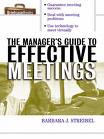
Book The Manager's Guide to Effective Meetings

by Barbara J. Streibel

In our increasingly collaborative work environment, the ability to manage results-driven meetings has become a critical career asset. Let The Manager's Guide to Effective Meetings provide you with a step-by-step template for energizing your next meeting, and transforming it from a roomful of clock-watching individuals into a collaboration of involved and enthusiastic partners.

(more ...)

Monday, June 30, 2008

Board Development - workshop, Sydney

Where: Sydney
When: 30 July 2008
Start time: 4pm
Finish time: 6pm
Are you a non-profit leader, or a current or potential board member? This afternoon workshop turns the spotlight on what’s required to make your non-profit board deliver. You’ll look at best practice, performance expectations and what it takes to make non-profit leaders and board members work effectively together.

To address the sector’s need for practical and affordable skills development, Social Ventures Australia has developed an integrated program of capacity building workshops specifically designed for non-profit organisations of all sizes and stages of development.

Led by qualified and experienced facilitators who are familiar with nonprofit culture and the unique issues we face, these workshops introduce key concepts of organisational and board development and offer specific techniques on how to apply them to your organisation.

SVA workshops are for non-profit leaders and managers. They’re short, sharp and focused to make sure your time out of the office makes your time in the office easier and more effective.

Why come?

Get tools and know-how that boost organisational outcomes
Apply your learning in real-time
Benefit from experienced facilitators and non-profit peer working
Cost: $200

For more information or to register download the workshop flyer.

Sunday, March 02, 2008

A New Tool for Resurrecting an Old Theory of the Firm


It's one of the oldest, most fundamental ideas in management theory: that executives should understand how the many distinct functional components of a firm -- production, distribution, product mix, human resources -- interrelate to achieve the proper fit.

For a firm to establish an effective, overarching strategic position relative to its competitors -- what management theorists call "firm positioning" -- the varied functional elements should, ideally, be complementary and reinforcing.

In recent years, however, this notion of comprehending the "part-whole" relationship of the firm fell out of favor as thinkers turned to other concepts to analyze and explain why organizations are effective. One well-known concept that emerged was the idea that companies could turn to core competencies to attain competitive advantage.

http://knowledge.wharton.upenn.edu/article.cfm?articleid=1480

Thursday, January 31, 2008

How Canon Got Its Flash Back


- The Innovative Turnaround Tactics of Fujio Mitarai'
Author: Nikkei, translated by Mark Schreiber and Aaron Martin Cohen
ISBN: 0-470-82123-X


If there were prizes for clever book titles, How Canon Got Its Flash Back would certainly be short-listed for a Best Book Title Award. But behind the amusingly apt title there is the serious story of Canons recent roller coaster ride. The company was one of Japans great success stories in the 1980s, approached the brink of financial disaster in the 1990s, and then turned the business around to re-achieve global supremacy in the past few years. The key to this recent success has been the strong personal leadership of Canons President and CEO, Fujio Mitarai. - Keith Hall


This book discusses the East-West style management strategies of its current president Fujio Mitarai (nephew of the founder, Takeshi Mitarai) that have turned Canon into a winner despite an increasingly dreary global economy. Mitarai was chosen as one of the world's top 25 managers in 2001 by leading US magazine BusinessWeek. Since taking office in 1995, Mitarai was viewed as a model for executives of large corporation throughout the world.
More information